Showing posts with label Alternative Technology. Show all posts

Tuesday, January 28, 2014

Linux: Configuring a Dongle (Mobile broadband)

I had some problems connecting to the Internet using a dongle (Huawei) on my old laptop running Linux (SUSE 12.3).  After many hours using various command line instruction found it was quite simple using NetworkManager.
If you have KDE or similar desktop installed, the NetworkManager icon is at the bottom right hand corner (just like Windows).  If it is not installed, use Yast and Install. 

Steps
Open the NetworkManager.
On the bottom right hand corner select Manage Connections.
The Add Edit Network connections window will open.
Select the Mobile Broadband Tab.
Add/Edit to go to Edit Network Connection window
  • Enter a connection name
  • Tick Connect Automatically
  • Number: *99#
  • APN: mobitel3g (see below for other Sri Lankan providers)
  • Tick  Allow roaming.
Thats it, OK and OK and back to Network Manager,

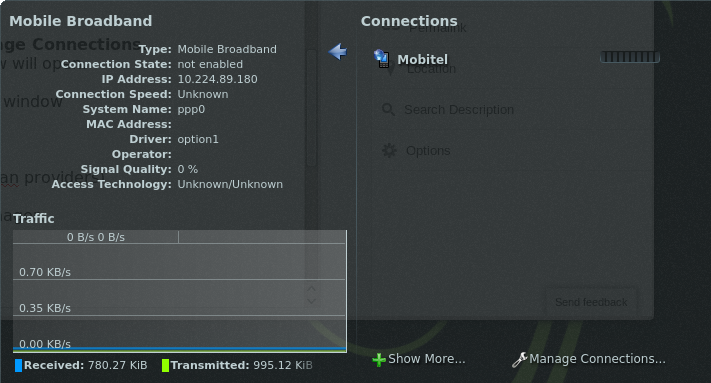
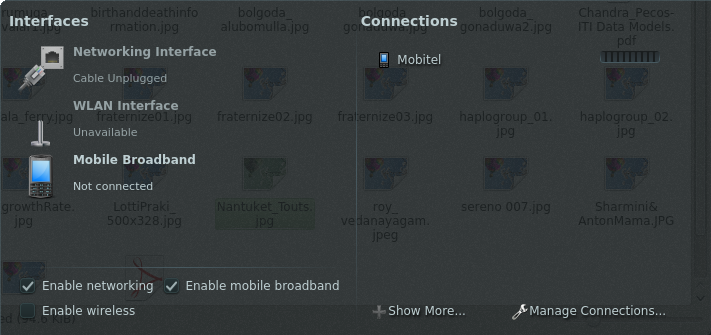
Nows the tricky part, or what took me a long time to figure out.  You may be taken to tab that shows info on the Mobile Broad band.  On the left hand tab use the arrow on top.  This will take you to the tab that shows all the Network Connections.  Click once on Enable Mobile Broadband. It may look like it did not get selected.  Just wait a few seconds and the Broadband connection will say initializing connection.


Model:        HP G60 Notebook
OS:             openSUSE 12.3 (x86_64)
Processor: AMD Athlon Dual-Core QL-64
Dongle    :  Micromax  (previously Huawei)


Access Point Names (APN) for Sri Lankan Mobile Broadband Operators 
Provider
Access Number
APN
Type
Etisalt
*99#
ebb
pre-paid
Mobitel
*99#
mobitel3g
pre-paid
Airtel
*99#
airtellive
pre-paid
Dialog
*99#
ppwap
pre-paid
Hutch
*99#
hutch3g
pre-paid

Monday, June 3, 2013

Vinegar a Test for Cervical Cancer

In Sri Lanka about 1,250 cases of cervical cancer are detected each year.  Nearly 50 percent of the patients die each year and is the second most dangerous cancer amongst women after breast cancer (LBO). Testing for cervical cancer in its initial stages is done by a Pap smear which requires laboratory work.

Now there is a simple visual test for cervical cancer using vinegar.

Excerpts
A simple vinegar test slashed cervical cancer death rates by one-third in a remarkable study of 150,000 women in the slums of India, where the disease is the top cancer killer of women.

This study tried a test that costs very little and can be done by local people with just two weeks of training and no fancy lab equipment. They swab the cervix with diluted vinegar, which can make abnormal cells briefly change color.

"It's just not possible to provide Pap smear screening in developing countries. We don't have that kind of money" or the staff or equipment, so a simpler method had to be found, Shastri said.

More progress against cervical cancer may come from last month's announcement that two companies will drastically lower prices on HPV vaccines for poor countries. Pilot projects will begin in Asia and Africa; the campaign aims to vaccinate more than 30 million girls in more than 40 countries by 2020.

via http://www.nakedcapitalism.com/2013/06/links-6313.html
http://news.yahoo.com/vinegar-cancer-test-saves-lives-india-study-finds-113800022.html

Monday, March 18, 2013

Beautiful Earth Kitchen

This is a great kitchen made completely with Earth (matti in Sinhala), Not only is it eye catching it is cost effective and very functional.  The kitchen was built by Mr. Dayananda and his wife Sumana by themselves. Mr. Dayananda's wife runs a medium scale plant nursery out in Wanathavillu (on the old Mannar Puttalam road). You may notice that Mr Dayananda is using one of the two or three many efficient ways of cooking with firewood (clay 1950-1978),
a) The double clay stove (CEB Two-pot Stove or the Clay Sarvodaya Version. 
b) Rocket Stoves:  Downside the wood needs to be chopped into small pieces. I have not seen one in SL. Does not mean there are none around. 
We/I use the double stove, readily available all over the country for around 150-250 LKR. It really cuts down on the firewood use and can have two pots being cooked at the same time. Unhappily I rarely see households using the double stove in this part of the country. The women walk half or more kilometer (depending on economic status) and gather firewood even though this area borders jungle. Thats because the village proper, is urban in the sense there are very few trees/firewood within the village.  Some villagers have have even commented after seeing the double clay stove why I bother. Yes some of those houses will have 50K sound setup or 30K flat screen TV, but not a 150-250 LKR stove that will cut down on firewood usage.


Tuesday, January 11, 2011

NY Times Post: Gas from Rice Husk

http://opinionator.blogs.nytimes.com/2011/01/10/a-light-in-india/?src=dayp

Excerpts:

This is why I’m writing today about a small but fast-growing off-grid electricity company based in Bihar called Husk Power Systems. It has created a system to turn rice husks into electricity that is reliable, eco-friendly and affordable for families that can spend only $2 a month for power. The company has 65 power units that serve a total of 30,000 households and is currently installing new systems at the rate of two to three per week.

One day he ran into a salesman who sold gasifiers — machines that burn organic materials in an oxygen restricted environment to produce biogas which can be used to power an engine. There was nothing new about gasifiers; they had been around for decades. People sometimes burned rice husks in them to supplement diesel fuel, which was expensive. “But nobody had thought to use rice husks to run a whole power system,” explained Pandey.

In Bihar, poverty is extreme. Pretty much everything that can be used will be used — recycled or burned or fed to animals. Rice husks are the big exception. When rice is milled, the outside kernel, or husk, is discarded. Because the husk contains a lot of silica, it doesn’t burn well for cooking. A recent Greenpeace study (pdf) reports that Bihar alone produces 1.8 billion kilograms of rice husk per year. Most of it ends up rotting in landfills and emitting methane, a greenhouse gas.

Tuesday, September 14, 2010

Compressed Soil Bricks

Compressed Soil Bricks at Saram Block Machines, Negombo
Its been over four months since I last posted. Not for the want of material, plenty of that. Just having the time and motivation both at the same occasion.

Could not postpone this, as Compressed Earth is pet project of mine. During the Tsunami managed send down two of machines  to make the block. One is lost somewhere in the customs and the other is under utilized in a Christian agency.

So whats the excitement, First I saw a place that actually sells machines to make Compressed Soil Blocks and with a little digging around found a place that sells the manufactured blocks/bricks.

Compressed Soil Brick Machine
A little background on why Compressed Soil Bricks are green, they dont use sand. So much sand is being dug up from river beds its not funny. When did you ever hear of 30-40 foot deep rivers in Sri Lanka. That is whats happening, the rivers are 30-40 feet deep, lower than sea level and becoming salty.

Compressed Soil Bricks are sold by Eco Ceylon
website: http://www.ecoceylon.com/index.php

Compressed Soil Brick Machines are sold by Saram Block Machine, Negombo
Phone: 031-2220557 Cell: 0777 386390
More info on Saram Soil Brick Machines here including prices.

More info on using Earth as Building material here including CEB