Wednesday, March 14, 2012

Basic Primer on Population DNA Genetics

Basically a primer meant to help understand a few blog posts on Sri Lankan Population Genetics I plan to be writing in the near future. Click here for the Latest list of  Sri Lankan Population Genetics Posts.


Genome
The genome is the entirety of an organism's hereditary information. It is encoded either in DNA or, for many types of virus , in RNA . The genome includes both the genes and the non-coding sequences of the DNA/RNA. The haploid human genome (23 chromosomes ) is estimated to be about 3.2 billion base pairs long and has about 20,000–25,000 distinct genes.

A human genome is written out in two chains of abut 3 billion chemical blocks (6 billion in all) that can be thought of as letters of an alphabet;  A(Adenine), C(Cytosine), G(Guanine), and T(Thymine).

Any person’s genome is derived from 47 stretches of DNA corresponding to 46 chromosomes and the mitochondrial DNA.  (A human cell has 23 pairs of chromosomes: 23 are paternal and 23 are maternal.).
Two of these chromosomes are identified as X and Y.  A father passes down both X and Y chromosomes, but the mother passes down no Y chromosomes.  Therefore, the paternal lineage is often traced using the Y chromosome.  Mitochondrial DNA is—one 200,000th portion of a genome—passed down along the maternal line only.

Gene

A gene consists of tiny fragments of the genome typically around 1000 letters longGenes are used as templates to assemble the proteins that do most of the work in cells.In between genes is noncoding DNA, sometimes referred to as junk DNA.

The gene is the molecular unit stretches of DNA and RNA which are the heredity of a living organism. A modern working definition of a gene is " a locatable region of genomic sequence, corresponding to a unit of inheritance, which is associated with regulatory regions, transcribed regions, and or other functional sequence region . Each gene has a specific location ( locus ) on a chromosome and may come in several forms (alleles). In simpler language the DNA that gives Brown Hair, the DNA that gives Black hair are both alleles of the hair color gene (more info here). A more detailed non technical introduction to the genomes and genes, is Introduction to genetics).


Genotype vs. Phenotype:
Very important concept. Even if the genes are identical (genotype) the outward expression / looks (phenotype) could be different. Example would be identical twin, who have the same genes will have differences and fingerprints will be different. Another example would be children of short parents (and also have the sort genes) could be taller because of better nutrition.

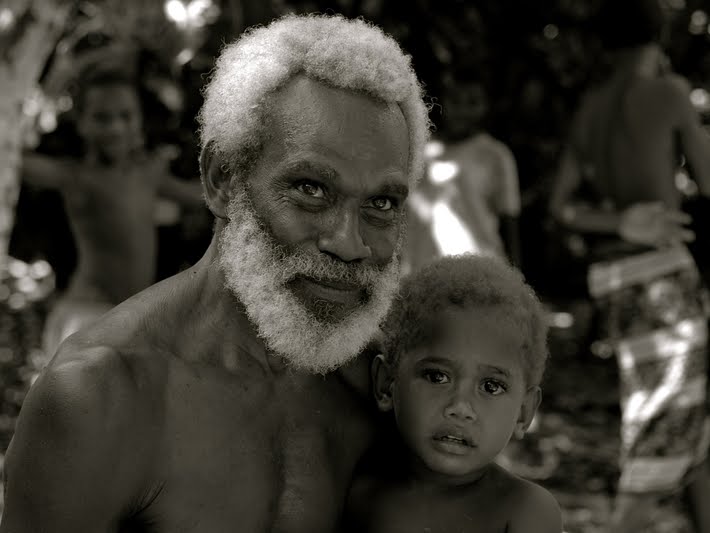
The opposite is also true in that just because outward appearance is similar (phenotype) the genes (genotype) do not have to be similar. Example: Africans and Papua New Guineans though superficially similar are about the furthest apart genetically.
African
Papua New Guinean

What Kind of Genetic Tests: (see here for more non technical info)
Humans have 22 pairs autosomal non sex related chromosomes. The other is a pair of X and Y, XX in the case of a female, XY in the case of a male. These are the tests currently available.
  • Y-DNA; This test is only for males (X-Chromosome) and gives your direct male ancestry. i.e. the genes that were passed down from, your fathers, fathers, father etc. Currently about 67 markers are tested.
  • mt-DNA: Males and Females can be tested. This gives the genes in the mitochondrial cells that were passed from your mothers, mothers, mother etc.
  • Autosomal: Males and Females can be tested. This tests the 22 pairs of autosomal non sex related chromosomes. Currently about 0.024% of about 3 billion base pairs are tested.
Assume there is genome that is Pure Sri Lankan and Pure European. Three generations ago the maternal great grand mother (DF=Direct Female) and Paternal great grandfather (DM=Direct Male) were Pure Sri Lankan. The maternal sides daughters and paternal side sons always marry Pure European.
When the Person gets tested the Y-DNA and mt-DNA test will show that they are Pure Sri Lankan. However the autosomal test will show 25% Sri Lankan and 75% European. That because 3 generations there were 8 great grand parents (2number generations=23=8). 2 were Sri Lankan (2/8=25%) and 6 were European (6/8=75%).

Testing and Results
I have almost no clue as to the steps between sending your saliva and getting your genome data. There is DNA amplification, get more copies of the same DNA from the small sample sent. Then probably analysis thru machines like the Illumina which are like 10th generation HPLC's ( High Pressure Liquid Chromatograph ).
Depending on the kind of machine (chip), then different parts of the genome (~0.024% of 32 billion base pairs) gets tested. That means when comparison and analysis of results from different machines needs to be done, then the common tested locations need to be extracted before analysis can be done. Say for example you got your autosomal tests done at FTDNA and you are submitting the results to a research group that has mainly 23andMe results. Then the researcher will have to extract the data common to both FTDNA and 23andMe before any analysis can be done.

Anyway once the analysis is done you will get a whole lot of results, ranging from heath to ancestry. Other than that you also get approx 5mb data file in text format.
What Can be done with the Raw DNA data
a) There is SNPTips a free Firefox extension that will automatically match your genotype SNP's with others.
b) You could analyse it at http://snpinfo.niehs.nih.gov/snpfunc.htm. Use rsid from example above and then paste into SNP Function Prediction or SNP Information in DNA Sequence see results. For SNP Function Prediction you need to click some of the boxes like "Based on Genotype Data from dbSNP" say Asian. I have no clue as to what the results mean, its going to be a learning curve.
d) Do more research yourself or participate (anonymously if you wish) in many of the projects, such as HarrapaDNA (for South Asian analysis), Dodecad Ancestry Project and Eurogenes Ancestry Project.

Data and Analysis
This section focuses on general outline of data preparation and analysis of the raw autosomal data.
The 5 mb raw autosomal data (from 23andMe) will look like below.
rsid       chromosome position genotype
rs3094315  1          742429    AG
rs12562034 1          758311    AG
rs3934834  1          995669    CC
rs9442372  1          1008567   AG
rs3737728  1          1011278   AG
rsid or SNP: Typically only 0.024% (still thousands) of SNP are tested at locations (positions) known for genetic diversity (there are about 3 billion base pairs).
chromosome: The chromosome number of the 22 pairs autosomal non sex related chromosomes.
position: Position (also called locus or marker) of the place tested..
genotype: The base pair (or alleles), one from each strand in double helix. Each will be one of the four bases that make the DNA A (adenine) , G (guanine), and T (thymine).

To do analysis and comparison for genetic affinities. (See here for an in depth description of using ADMIXTURE at Razib Khan's Gene Expression and Anderson et al (2010) Data Control..(complete pdf).
Note: There is a software program ADMIXTURE and admixture the process of mixing of genes.

  1. Your raw data is combined with thousands of other genomes, some available freely from studies and others handed over by people who have got their genome test.
  2. Software like plink is used to do genome association analysis. Additionally it is used to create standard file formats that are used as inputs to other genome analysis software such as ADMIXTURE
  3. ADMIXTURE's input is binary PLINK (.bed) or ordinary PLINK (.ped and .map). The plink .ped file contains the genotype information (which SNP variants are where) and the .map file is essentially a list of the SNP names.
  4. To use ADMIXTURE, you need an idea of K, your belief of the number of ancestral populations.
  5. You can run ADMIXTURE in regular mode or supervised mode. Supervised mode is essentially anchoring ouptut to some reference populations. The reference population can either be autosomal data of real individuals or zombies. Zombies are recreated data to reference a hypothetical genetically pure indidividual or population (genomes created using the --simulate option of plink from allele frequencies) .
Important Caveats
  • Admixture analysis cannot distinguish between recent and ancient gene flow or directionality of flow
  • It is important to recognize that regions of highest haplo group frequency are not necessarily representative of origin. An obvious example is haplo group C, which displays its highest frequency in Polynesia (Kayser et al. 2000), but Polynesia is one of the last regions known to be colonized by modern humans (Sengupta et al, 2005).
  • Linguistic and Cultural (possible proxies for "Race") groups may not be the not the same as the genetic grouping.

Monday, March 12, 2012

Otter who raised orphaned pups, inspired law dies

The main reason for this post was more about Otters in Sri Lanka. I know there are Otters (Diya Balla) in Sri Lanka. They are supposed to be found around lagoons and mangroves. If you talk to old timers who live near the Negombo and Rathgama/Dodanduwa Lagoons will say that Otters were quite common when they were growing up. That said, Shirmp Trap (Isso Kotu) owners detested the otters as they would enter the trap and eat the shrimp and get away.

I have yet to see an Otter (other than the ones in Otters) in Sri Lanka. Not even a photograph, even though I have lived on the banks of Negombo and Rathgama/Dodanduwa Lagoons for the last couple of years. Not even a photograph, Sad.

Does anyone have photos of Otters of Sri Lanka. Do you want to provide a link or I could post it with credit to you.

Anyway here is a good story.
The California sea otter, who died Saturday in Monterey, not only raised more than a dozen orphaned otter pups, but also inspired important legislation and changed the way scientists handle abandoned otter babies.

And she did it all while battling a chronic neurological illness.

All that changed with Toola. She arrived at the aquarium in July 2001 after someone found her floundering and pregnant on Pismo Beach. Aquarium veterinarians discovered she had toxoplasmosis, a parasite spread by cat feces and a common threat to sea otters.The pathogen had infected her brain, leaving her with frequent seizures and an almost certain death sentence. Aquarium staff were able to control her convulsions with twice-daily doses of Phenobarbital, but she would never be released back to the wild.

A month or two after arriving at the aquarium, Toola gave birth to a stillborn pup. That's when Toola's motherhood miracle happened.
Toola didn't hesitate. She nursed the orphaned phttp://www.blogger.com/img/blank.gifup like he was her own, taught him to open clamshells with rocks, how to eat a crab without getting pinched, and other tricks of sea otter life.
That pup, raised by Toola instead of humans, was able to return to the Pacific, where he's now king of a pack at Elkhorn Slough and has fathered countless pups himself.
Toola went on to foster 12 more pups, each for five months or so. Of the 13, two are still at the aquarium, too young for release; five are cavorting around the coastline making babies of their own; and six are unaccounted for, either dead or having shaken off their tracking tags.
Toola's most recent foster child was a male whom she was cuddling as recently as Friday. Late in the day, staff noticed she was listless and refusing food, and early Saturday she died naturally at the aquarium, surrounded by staff and her otter friends. She was 15 or 16.
Complete article here.

Wild Boar in NY State: Open Season

Wild boar in New York. Hopefully some enterprising Sri Lankan will start supplying the NY Metro and New Jersey Sri Lankan population with Wild Boar.
Anyway here are excerpts from the article.
First the most important statement:
In New York, the state’s ordinarily strict hunting rules have b..een relaxed for feral swine. The Department of Environmental Conservation’s Web site advises those with small game licenses to “shoot and keep feral swine at any time and in any number.”

PERU, N.Y. — They roam by night, picking cornstalks clean, making off with apple crops. They have almost no natural predators, but they have razor-sharp tusks and a seemingly bottomless appetite for plants and animals. Their population can triple in one year.
They are feral pigs, and while they have long plagued parts of the S
outhern and Western United States, now they have become a problem in the peaceful Champlain Valley of New York, an agricultural heartland on the edge of the Adirondacks.
They carry disease and can be aggressive toward people. They have even inspired a new television series, “Hogs Gone Wild,” about efforts to hunt them from Hawaii to Alabama. Perhaps most worrisome is their reputation as eating machines: the pigs devour ground-nesting birds and reptiles, fawns and domestic livestock, native vegetation and crops. Feral pigs have already proliferated in parts of western New York.
Complete Article here
http://www.nytimes.com/2012/03/12/nyregion/feral-pigs-plaguing-upstate-new-york.html?

Tuesday, March 6, 2012

Pariah Dog and Sinhala Hound

This post is mainly a extraction from Wikis for Sinhala Hound and Pariah Dogs and Indian pariah dog

I dont know why its Sinhala Hound and not Sri Lankan Hound.

The Indian pariah dog is a purebred dog category of pariah dog. The Indian Native Dog (INDog) is an ancient autochthonous (landrace) type of dog that is found all over South Asia. The Indian Native Dog and is nowadays referred to as the INDog by experts and enthusiasts. The term "Pariah Dog" is not derogatory in the canine context and refers to a class of primitive dogs of a specific appearance known as the "long-term pariah morph." The United Kennel Club (United States) recognizes purebred dogs bred for chasing large game in the Sighthound & Pariah Group. Included in this group are breeds that are either of early origin or modern reconstructions of early breeds or types.

Where not mixed with the blood of European dogs or other breeds and types, it is remarkably uniform in appearance all across the entire country...The type represents one of the few remaining examples of mankind's original domestic dog and its physical features are the same as those of the dogs whose fossil remains have been found in various parts of the world, from very early remains in Israel and China to later ones such as those found in the volcanic lava at Pompeii, near Naples in Italy. In India these were the hunting partners and companion animals of the aboriginal peoples of India...they are still found with the aboriginal communities who live in forested areas. Since these dogs have never been selectively bred, their appearance, physical features and mental characteristics are created by the process of natural selection alone.

INDogs are extremely alert and social. They make excellent watch dogs due to their territorial instincts. Their ruralevolution, close to forests where predators were common has made them extremely cautious and this caution is not to be mistaken for lack of courage. They bark at the slightest doubt or provocation and hence can be very noisy.

Other articles:
indianpariahdog.blogspot.com 
http://www.nytimes.com/2013/07/16/science/a-dog-that-goes-way-back.html
http://www.nature.com/news/genomes-link-aboriginal-australians-to-indians-1.12219

Saturday, March 3, 2012

Jazzfied Carnatic Music: from Shankar Tucker

I think I got introduced to this from Brown Pundits, maybe a Nandalal Rasiah post.

So whats with Carnatic Music. I remember my Uncle (Periappa) listening to this kind of music, while my cousin Robin was listening to Deep Purples Fireball (my Intro to rock, and still a great favorite). I too am starting to get what my Uncle Periappa heard. Deep music, just like the Blues of America. Then to sing the Blues you have to hurt and we dont have that in Sri Lanka.

So in Sri Lanka we will have the rhythm, beat and happiness (think papare), but never the depth and sadness of song as in the Blues. So what I am trying to say is maybe its really hard to be to be really sad, down and out and sing the blues in Sri Lanka.

Anyways here is the Jazzfied Carnatic Music from Shankar Tucker


Friday, March 2, 2012

Poisoning vs. Road Traffic Injuries as a Cause of Death in Rural Sri Lanka

Nice article by Michael Eddleston et al in PlosOne which says Poisoning bigger cause of Death than Road accidents in Rural (North Western Province) Sri Lanka.

Here is breakdown of the numbers of the biggest causes of death. Obviously most of the poisoning cases are self inflicted and the road deaths accidental. You can access and read the whole article here.

NY Times: Fidelity Ad: Investment Opportunities in Water

Back to Water as valuable resource of Sri Lanka.

Todays NY Times had a advertisement from Fidelity Investments about investment opportunities in Water. Fidelity Investments is is one of the largest US mutual fund companies with nearly $3.3 trillion in assets under administration and $1.5 trillion of assets under management.

Anyway here is the wording in the ad.

It takes 35 gallons of water to make one cup of coffee. Why? Because of all the water used to cultivate coffee beans. Similarly, it can take about 635 gallons to make one hamburger because of all the water required to grow feed for the cows.
The need for clean fresh water is increasing rapidly, too, as populations rise and standards of living improve around the world. In some places -- such as central California, the North China Plains, and parts of India -- the demand for water is already outstripping the local supply.

Because global water consumption is expected to increase by 40% over the next 20 years, water shortages may get more acute and widespread, spurring more reliance on desalination technologies, water reuse, and conservation. The results could have massive economic, ecological, and geopolitical consequences, creating investing opportunities in places you may never have considered.
This advertisement should be read in context of the following posts.