Friday, August 5, 2011

AC CTB Buses and the Southern Highway

CTB (SLTB to be exact has AC buses running from Moratuwa to Pettah. Currently only two buses and within the next few days two more to be added. By the end of the month they expect to have fleet of forty buses. Some of the buses are to be deployed on the Southern highway which apparent scheduled to be opened on August 15th. The fare from Pettah to Galle is to be LKR 350/=. The Fare from Bambalapitiya to Pettah was LKR 26/=.

Update
As of Jan 2014 (and earlier) the Southern Highway Buses run only from Maharagama .  The fare is LKR 500. Journey is one and half hours (none rush hours) from Maharagama to Galle. It seems like the private buses have less air conditioning compared to the SLTB buses.

The worst public bus station toilet is in Maharagama. Much worse than Chilaw which is quite bad to start with. Surprised no one has complained.

Check with Pettah Central Bus Stand (+94) 11 2329604-5 about changes.

Info on Katunayake/Negombo to Pettah Highway service.


Saturday, July 23, 2011

Christian Fundamentalist Bomber In Norway

http://www.nytimes.com/2011/07/24/world/europe/24oslo.html


The rumor is that apparently the Sri Lankan govt is ready to provide refugee status in Sri Lanka to this oppressed group of Christian Fundamentalists . In addition the SL govt is willing to provide the the services of Dr Palitha Kohona and Dayan Jayatilleke to negotiate a separate state for these oppressed Christian Fundamentalists in Norway.

OSLO — The Norwegian police on Saturday charged a 32-year-old man, whom they identified as a Christian fundamentalist with right-wing connections, over the bombing of a government center here and a shooting attack on a nearby island that together left at least 91 people dead.

Tuesday, May 31, 2011

By Bus: Mannar, Pooneryn to Jaffna: Part 1 Mannar

Part 2 here and Part 3 here
The last time I visited Jaffna was in late 2004. Thats not the absolute truth, because I did go to Jaffna in December 2010. That was with two classmates and their families and I was in a perpetual haze and trying to be (I dont think I needed to try hard) to be a nuisance. Into the bargain the camera had stopped working. It started working again when my brain was a little more coherent and I hit it, as in the camera against the wall. This works for my brain as well at times.

The 2004 trip was quite a journey. Many a story and one of these days I will get around to writing about it. The LTTE customs checkpoint, the LTTE exhibition at Kilinochi. Photos from that trip and blog post on that trip here.

Anyway as usual before going to any place where I dont know the language, brushed up with some useful phrases which work wonders like;
Amma/Aiya Onglaku Mitchum Nanri: Madame/Sir thank you very much.
Theivadu, Thanni konjam Tharungo: Please can I get a little water (replace Thanni=water with whatever)
Ungalaku Nalla Naal: You have a good day. I would replace Naal=day with Rathri=Night, in the evening. My vocabulary did not extend to the word for evening
Back to the bus trip. Left Colombo 6:45 am semi luxury (no different from normal buses, just higher price). Cost LKR 400 per person. I dont like air con buses for long distances. It seems they either turn off the air con off or if it is cold enough to my liking, the other passengers want the cold turned down. Normal buses, you get a corner seat making sure the window is under your control, i.e. it closes/opens at your seat. If your neighbor complains its too cold, the drizzle is coming in, explain that you vomit all over the place if you dont have a window open. One time while traveling up country early with a frigid air blowing on my face, explained that I do my morning meditation and the cold air helps me focus my mind on the Dhamma. Nothing like religion to exploit your needs or foibles. On the other hand you could have the odd swig or too from a bottle of booze. You will not be asked any questions, in fact many will keep a healthy distance from you. More likely you will be the loquacious question asker.

A few other things like if it is a North South oriented journey, sit on the west side before noon and on east after noon to avoid direct sun. Too bad if what you want see is on side of the sun, like a west coast ride in the afternoon and you want to see the ocean.

Arrived in Mannar at around 3:30 p.m. Stayed at the Manjula Inn (2nd Cross St, Mannar; Tel 023 2222037, Mobile  077-6038525), walking distance from the bus stand. Its a house from the 50's a section of which has been converted to an Inn. I stayed in one of the upstairs rooms, attached toilet. Place is clean, toilet tiled and clean but the drain was of cement and didnt look too attractive. That said this place is not let out on a short term basis, i.e. you dont have to be wondering who was doing what in the bed a few hours before you checked into the room. The owner Sam Ratnaraj, a retired gent was displaced from Negombo during the 83 riots and moved to Mannar his wifes hometown. Strong and vocal opinions of what has happened and should happen but no wish to settle elsewhere. Sam is also otherwise busy at the moment funding his two grand kids thru University in the UK.

The evening I arrived did the standard Baobab Tree and the Mannar Fort and the Donkeys. Late evening did a pleasant 3 km walk to the Mannar Station (destroyed by the LTTE). This was kind of a forced walk. The three wheel guy asked for LKR 300 and probably should have been around LKR 100 (approx 30 to 35/km), so walked, a good decision in retrospect as it was a nice pleasant area. Hopped a three wheel back for LKR 150.

The Little Donkey in the Mannar Fort

The Donkey Family framed from a window. Inside the Fort: I think this was the Chapel
The Mannar Bridge. The metal bridge was constructed by Kobbekaduwa (I think) after the old Mannar bridge was blasted by the LTTE. The more permanent concrete bridge is of recent vintage.

The Baobab Tree
The Mannar Railway bridge, blasted by the LTTE

The remnants Mannar Railway Station
More photos and other locations in the vicinity by another author http://trips.lakdasun.org/trip-to-mannar-and-talei-mannar.htm

Next: Part 2: Talaimannar and Madhu

By Bus: Mannar, Pooneryn to Jaffna: Part 2 Talaimannar and Madhu

(Part 1 here and  Part 3 here)
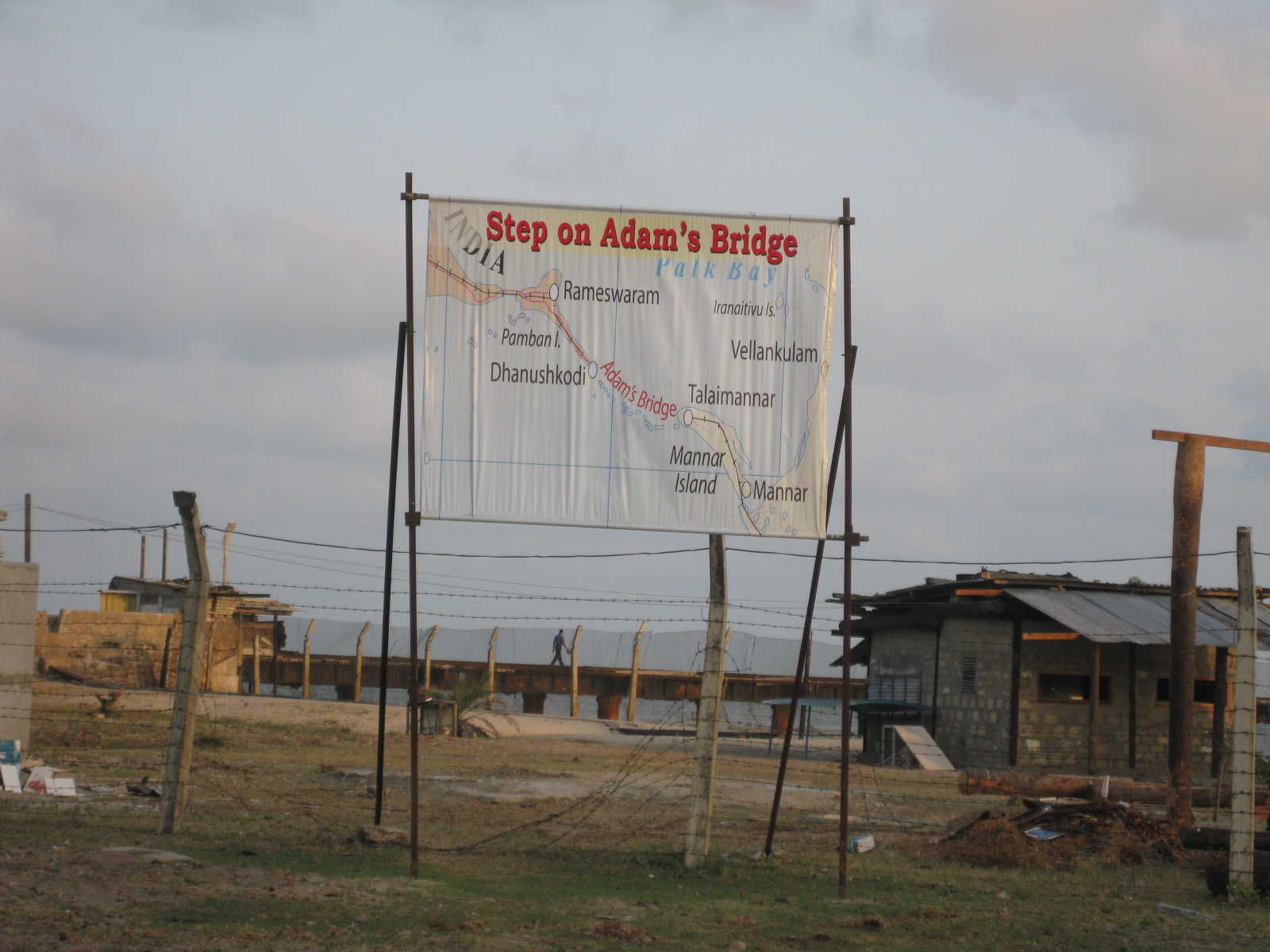
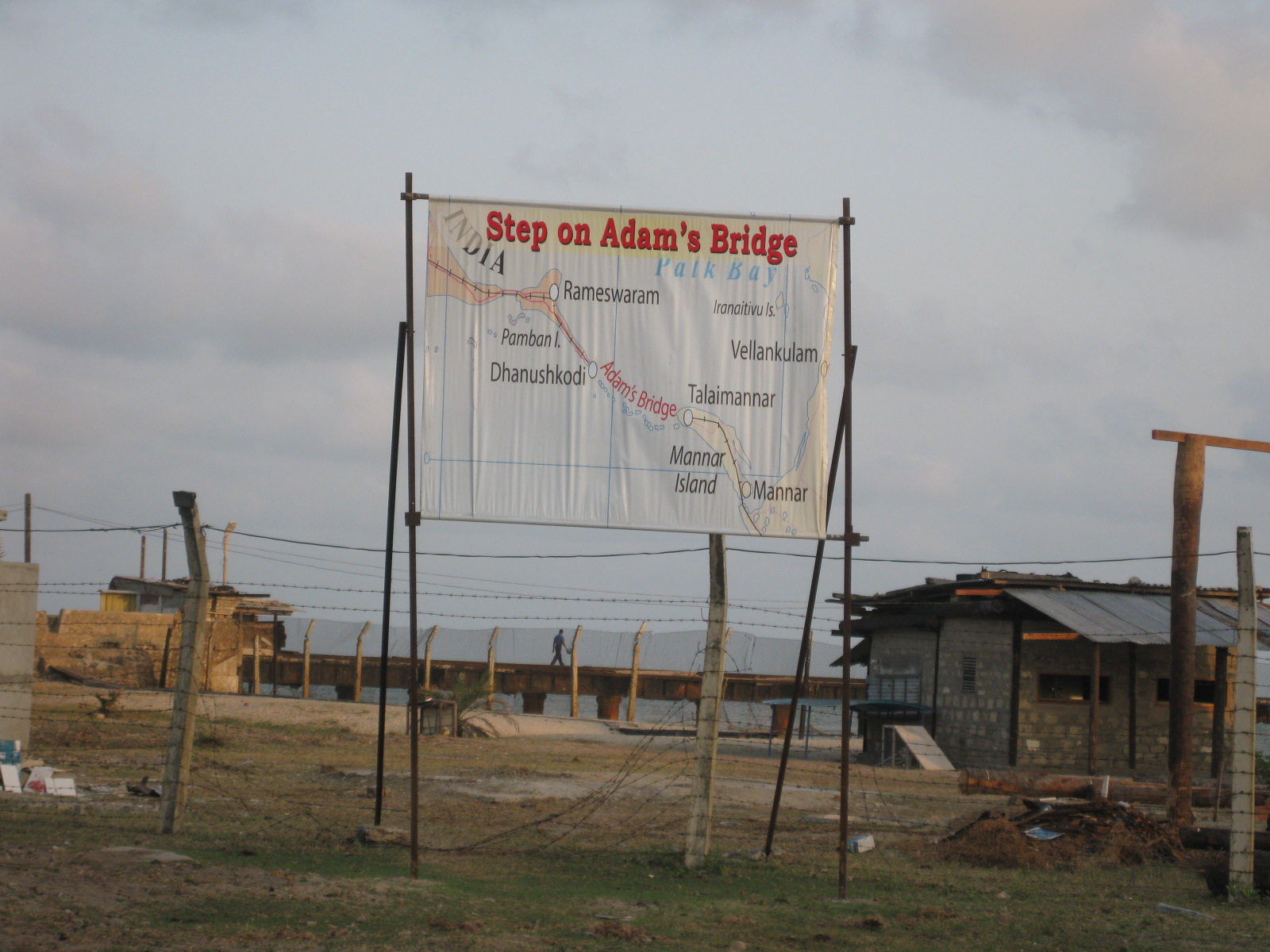
Day 2: One of the main purposes of visiting Mannar was to do the Navy Boat Ride to the Adams Bridge sand bank islands from Mannar. The other was to scout any coral reefs for snorkeling. More on the coral reef later in the post.
Of course there was no other info about the boat ride on the Navy website press release. Luckily while passing the entrance to Madhu, saw a big banner and a contact phone number. Called them the previous day and found that the first ride was around 7:00 am and was for 3 hours. Talaimannar is 30 km, so assuming the bus does an average of 30 kmph, it would be one hour from Talaimannar. Found out a SLTB bus from Colombo arrives around 4:30 am on the way to Talaiannar. The short story is missed the bus, it had come in at 4:10 am. There did not seem to be any buses till after 6:00 am. So bargained for a three wheeler for LKR 1,000 and the going rate can be anywhere from a LKR 1,000 to LKR 1,500. The reasonable rate is LKR 1,000, i.e. 30 km into LKR 30/km. Was in Talaimannar by 6:15 am. Had Pol Roti and Dried sprats (Hal Masso) curry for breakfast which was very tasty from a small store nearby.

Drifted towards the pier, around 7:00 am. I was the only one there. The wind was quite strong with white caps on the water implying wind speeds of at least about 18 mph. The Navy boats are small and with waves increasing offshore its quite dangerous to take them out in high wind conditions. Hung around till 9:00 am and the wind wasnt dying down so headed back to Mannar.

This operation/tour has been cancelled. Navy no longer operates tours to Adams bridge

Details on Navy-operated boat trips to Adam's Bridge
Contact Number: 023-2281081
Cost per Person: LKR 500. The boat needs a minimum of LKR 3,000 to be cost effective. So if no one else turns up, expect to pay LKR 3,000 for even one person.
Duration: 3 hours. About and hour and fifteen minutes each way, and half hour on the Adams bridge sand bank.
Other: Please call and check conditions to see if there is a possibility the seas are rough.
This is all of Talaimannar town. One street with stores and house for about 300 meters
Bank of Ceylon. Assume they dont have too many bank robberies.
The sign at the Navy entrance.
Eligibility for Sand Tour. Not Drunken, which I assume is quite often a reason for ineligibility
The light house. In the foreground a restaurant and waiting area is in the process of being constructed.
Headed back to Mannar at 9;00 am. The bus ride was less than an hour. Not many stops on the way and the bus just zoomed back.

Headed to Madhu church on an Vavuniya bus and got off at the Madhu church turn off. Its 12 km from the Mannar-Medawachiya road to the church. Its LKR 400 by three wheeler. However, if you hang around most passing vehicles will give you a ride to the church. That was exactly what I did. After standing around for about all of 5 minutes a passing van picked me and about four others going to villages nearby.

Madhu, what can I say. Nice enough church but not what I would travel hundreds of kilometers for its aesthetic value. Assume if you have faith, then it would be a different matter. Anyway, saw the place and know what Catholics (and some Buddhists) speak of when referring to a trip to Madhu. Had a decent rice and curry (beef, my favorite) from the church operated Restaurant for about LKR 120 and headed back. There are buses every two hours to and from Mannar. Anyway same process, hung around for about 10 mins and got a ride back to Madhu junction.
The main entrance to Madhu Church
Madu Church
Choice Hotel, Grand Bazaar Road. This place has mutton, cuttle fish (dhallo) and Prawns.
Finally to the Coral Reefs. Inquired around and no one quite knew about coral reefs. Some mentioned the possibility of there being reefs around Arippu. Arippu was apparently where the Pearl fisheries were located. However the photographs of this blog post show nice beaches near Arippu which does not seem indicative of coral reefs near the shore.
Some of the fisherman were also complaining that the Indian Trawlers are allowed to come in Sri Lankan territorial water twice a week. The Indian trawlers apparently do bottom trawling. To quote from wiki
Because bottom trawling involves towing heavy fishing gear over the seabed, it can cause large scale destruction on the ocean bottom, including coral shattering, damage to habitats and removal of seaweed, that clean the sea floor, destroying coral and just decimating fish populations
The deep sea fishermen around Mannar are mainly from the Negombo area and are the ones most affected by Indian bottom trawling. Apparently the local population is only involved in shallow water fishing and shrimping and as such dont care about the Indian Trawlers.

Next: Part 3: Mannar to Jaffna thru Pooneryn

By Bus: Mannar, Pooneryn to Jaffna: Part 3 Mannar to Jaffna thru Pooneryn

Part 1 here and Part 2 here
Day 3: Went by bus from Mannar thru Pooneryn to Jaffna, which is about 100 km. The bus left at about 8:45 am and arrived at around 2:00 pm in Jaffna. Many stops and waiting while passengers unloaded stuff for stores along the route or loaded produce for sale in Jaffna. The cost of the ticket was LKR 160 which seems high when compared with Colombo to Galle which is 120 km and costs LKR 110. However, when one considers the condition of the road and the wear and tear, the price seems reasonable.

Most of the road is still gravel, (however, not many huge ruts) . The first few kilometers from Mannar is quite fancy; carpeted road with side pavements. The final stretch too, entering the Jaffna Peninsula is also quite good. This is thru the Jaffna lagoon and the disused Mahadeva Causeway (built in 1932) has been rebuilt, and the ferry has been replaced with the Sangupiddy bridge. According to bridge builders website this bridge was a
part of the ongoing Regional Bridge Project. The Atlas bridge was originally destined for use as a flyover at the Panadura junction in Colombo. However, having identified the North Western Province as a priority development location and following detailed investigations, the Ministry decided instead to build the structure as an Atlas Bridge in Sangupiddy.
The Sunday Observer article attributes the original idea of the causeway to
The engineering genius Mahadeva, who was the brainchild behind building the Elephant Pass causeway, had first worked out a plan to connect Sangupiddy in Jaffna and Kerathivu in Pooneryn by constructing a causeway in the shallow lagoon waters. However, the plan did not materialise due to protests from the fisherfolk in the area and producers of salt in Elephant Pass.
According to the Tamil News Network of Jan 16th 2011
So far, there is no announcement when civilians would be able to use the causeway. In recent times, only the occupying military has been using the causeway.
As far as I know the bus has been running for sometime, so you now know contrary to the Tamil News Network civilians use the causeway. There were also a couple of people in Jaffna who talked about the only way to reach south was through Pooneryn for many years. They would take boats and go across while avoiding bombs and crossfire.

Update:
Wilpattu House Cottages / Bungalow / Hotel  located by the Puttalam-Mannar Road, Eluvamkulam Entrance to Wilpattu National Park  is an ideal place for stopovers for an itinerary of Kalpitiya - Eluvamkulam (Wilpattu National Park) - Mannar - Pooneryn- Jaffna by bus/bicycle/motorbike. They also help arrange transport of cyclists across Wilpattu National Park.

The Mannar Pooneryn road near Mannar.
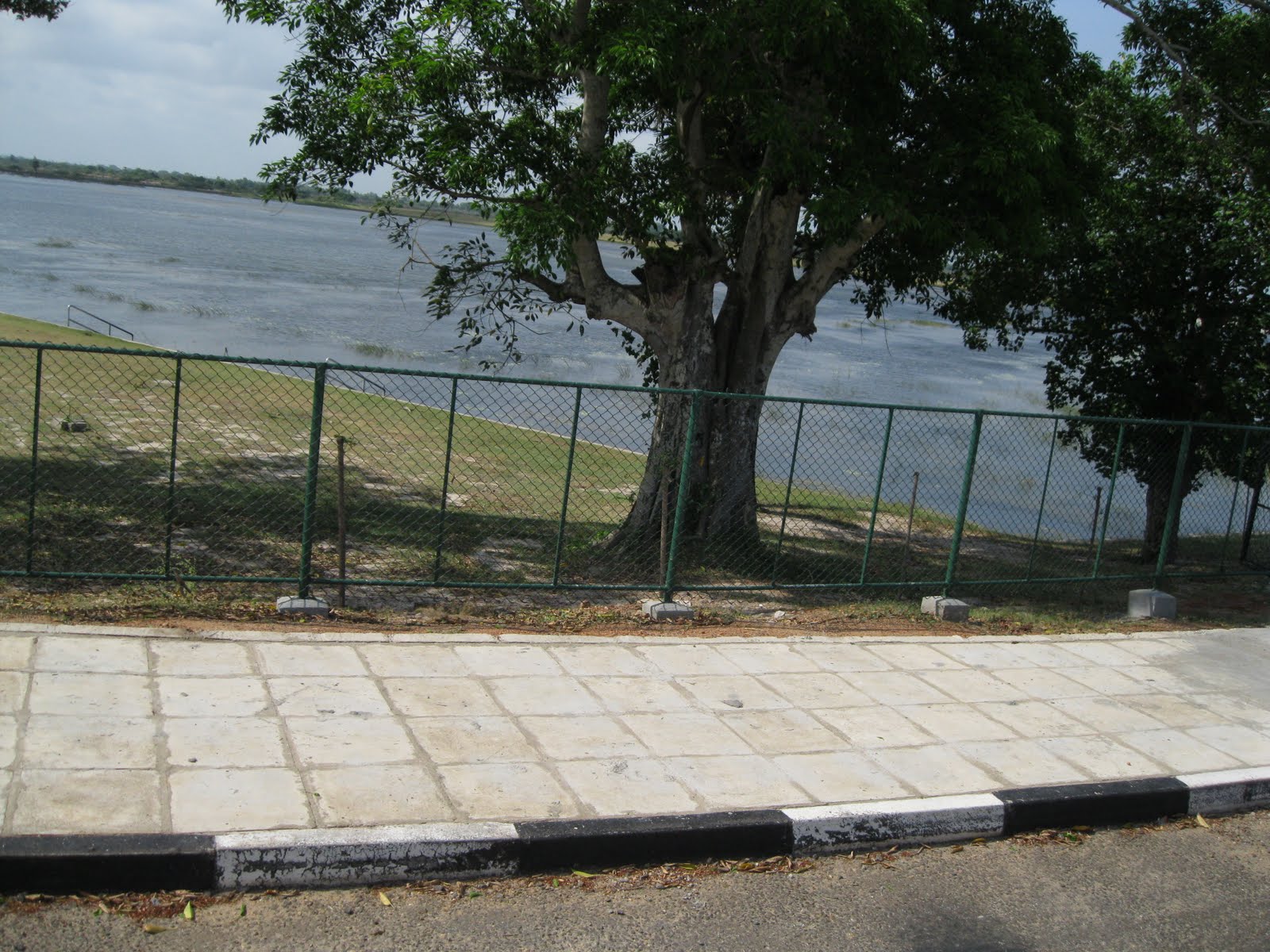
A lake closer to Mannar on the Mannar Pooneryn road

Typical view of toward the Mannar area of the Mannar Pooneryn Road. As one travels further north the landscape becomes more fertile.
Getting off the Bus and walking to the villages. It seemed like most villages were located off the road and toward the ocean. The priest at Mulangavil asking for alms, offerings
Kovil at Mulangavil. I think its similar to the Kovil at Murugandy where offerings (panduru) are made for a safe journey.
The bus is parked among the trees near the temple for a break in the journey.
One of the three stores in Mulangavil
One of the many Catholic Churches along the road

This kid on the bus didnt know a word of Sinhalese or English. I barely knew any Tamil. However, we had a little rapport and he kept on pointing out the approaching views such as the entrance to the causeway and the beginning of the bridge. If it was not for this kid, no proper photos of causeway and bridge as it would have passed by before I got my camera ready. Regret not having asked for his name.

The start of the Mahadeva Causeway, Pooneryn side
The Mahadeva Causeway

End of the Sangupiddy bridge, approaching Sangupiddy, Jaffna

Tuesday, April 26, 2011

Sunday Top of Pops (?): Late Sixties

My classmate Kavindra Nethsingha sent me this link about the Diamonds, Little Darling
It just evoked an whole host of memories, the Sunday afternoon Radio Ceylon program at around 2 pm on Sunday. This was the late sixties, early seventies no TV at that time and I was a pre teen. The theme song to the program was by the Platters, "To Each his Own" (1959). I recalled it as the "Sun and the Rain" and Jagdish Mirchandani set me right including that it was the Platters who sang the song.

Anyways, 40 years later I still recall these songs and dragged them out from the deep recesses of my memory and see a common theme. The theme being African American singers. At that time I a 9-10 year old did not know who were African Americans. Preconditioning or triggering latent tastes. Then my parents too loved Paul Robeson, all American superstar who was blacklisted by the US govt. I just wonder if my parents knew he was a Black African American. Unhappily for an African American and son of a slave who is known world over, very few contemporary African Americans know his background, even though they may have heard his songs.
Robeson was an All-American athlete, and Phi Beta Kappa Society laureate during his years at Rutgers University. In 1923, Robeson drifted into amateur theater work and within a decade he had become an international star of stage, screen, radio and film. Robeson went on to be a recipient of the NAACP's Spingarn Medal, the Stalin Peace Prize and of honorary memberships in over half a dozen trade unions.[4][5][6][7] James Earl Jones, Sidney Poitier and Harry Belafonte have cited Robeson's lead film roles as being the first to display dignity for black actors and pride in African heritage.[8][9] Though one of the most internationally famous people of the 20th century, blacklisting during the Cold War has nearly erased Robeson from mainstream interpretations of history.[6]
Then as a teenager Eric Fernando (and Mahes (?) a lady) just sealed the deal with them playing more of the same. Recall Rose Royce (yes really) among the less well known African American groups being played.

See below, the Platters "To Each his Own" (1959), then Paul Robesons Summertime (1936) and Janis Joplins version of Summertime (1969) and finally Paul Robeson's version of "Sometimes I Feel Like a Motherless Child" from 1926. Paul Robeson's Ole Man River, 1936 as well as Swing Low Sweet Chariot I recall were hits with my father. All other than Janis Joplin used to be played on the Top of the Pops
  • The song dates back to the era of slavery in the United States when it was common practice to sell children of slaves away from their parents. An early performance of the song dates back to the 1870s by the Fisk Jubilee Singers.[1][2] Like many traditional songs, it has many variations and has been recorded widely (see partial lists of choral arrangements and covers below).
Platters: To Each His Own (1959)


Paul Robeson: Summertime (1936)


Janis Joplin: Summertime (1969)


Wednesday, April 20, 2011

Land Reform, Big Ag and Social Unrest

My friend Rajaratarala has a blog post on that argues land reforms of the 70's caused economically unfeasible sizes of agricultural property.

My contention is that land reform has brought social stability specially during economic downturns. Yes, sounds idiotic given that we are coming out of a 30 year civil war. But then there were no large landholdings in the North, so no gain from land reform to the poorer section. They were probably expecting jobs, University entrance etc which is an whole other discussion. Whats more applicable was the JVP insurrection which kind of disappeared after the reforms.

The opposite example is the US, where since the 60's small holders have been sold out to Big Ag.
In 1962, a committee of the most powerful corporate executives in the United States issued "An Adaptive Program for Agriculture," a plan to eliminate farmers and farms. Called the Committee for Economic Development, this group represented oil and gas, insurance, investment and retail concerns as well as the food industry. Industry giants such as Campbell Soup, General Foods, Pillsbury and Swift lobbied Congress with the message that the biggest problem in agriculture was too many farmers. The U.S. government encouraged farmers to move off their farms and retrain, allowing their land to be consolidated in the ownership of fewer and fewer corporations.

The Bill
AN ADAPTIVE PROGRAM FOR AGRICULTURE

This has resulted in extreme urbanization even ghettos (Projects e.g. Cabrini Green). These are social powder kegs that would explode in unrest. The two main reasons that have kept the lid on is high employment and welfare programs. There are cynics who also think drugs and alcohol prevent organized unrest. Anyway with decrease in welfare and increasing unemployment expect social unrest where the Watts Riots would look like a picnic.

Some other thoughts of the US and Global Agri systems.
http://www.theoildrum.com/node/6575
Farming itself is the least profitable and least energy intensive segment of the entire economy of agriculture. Of the roughly 2,000 liters of oil required per year to feed each American (Pimentel 459), only one-fifth of that energy is actually used for agriculture, with the rest going toward transport, processing, packaging, marketing, and food preparation and storage (Brown 35). The transformation of farm products into consumer commodities, along with the provision of farm inputs, are the biggest moneymakers in the American food system, and not surprisingly, the sectors dominated by large agrifood corporations. Farmers operating under the capitalist system must sell their products on the open market, which usually means selling to the large transnational corporations that dominate the market.

The example of Cuba shows that it is possible to feed an entire nation with organic agriculture, but it also demonstrates the hardships involved in moving away from fossil fuels. In the first few years after the Soviet Union’s collapse, the average Cuban’s daily caloric intake decreased by 36 percent and protein consumption by 40 percent, while undernourishment increased by 15 percent (Pfeiffer 57). It must be noted that Cuban government policies played a critical role in helping to ensure that the collapse of industrialized agriculture did not turn catastrophic. There has also been a change in attitude towards farming amongst the Cuban people. Cubans now see farming as an important and profitable endeavor and many families have migrated to rural areas to become farmers or have started urban gardens (Pfeiffer 60).