Tuesday, January 28, 2014

Linux: Configuring a Dongle (Mobile broadband)

I had some problems connecting to the Internet using a dongle (Huawei) on my old laptop running Linux (SUSE 12.3).  After many hours using various command line instruction found it was quite simple using NetworkManager.
If you have KDE or similar desktop installed, the NetworkManager icon is at the bottom right hand corner (just like Windows).  If it is not installed, use Yast and Install. 

Steps
Open the NetworkManager.
On the bottom right hand corner select Manage Connections.
The Add Edit Network connections window will open.
Select the Mobile Broadband Tab.
Add/Edit to go to Edit Network Connection window
  • Enter a connection name
  • Tick Connect Automatically
  • Number: *99#
  • APN: mobitel3g (see below for other Sri Lankan providers)
  • Tick  Allow roaming.
Thats it, OK and OK and back to Network Manager,

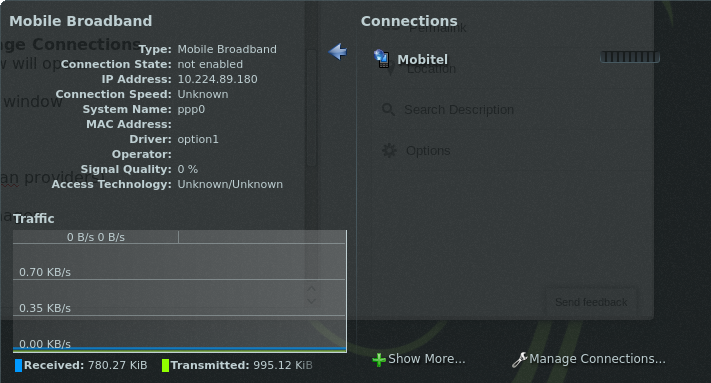
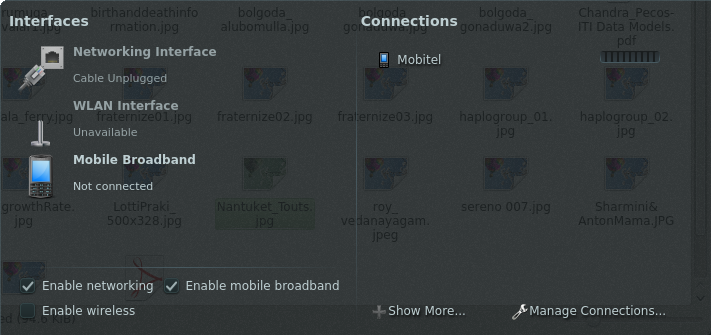
Nows the tricky part, or what took me a long time to figure out.  You may be taken to tab that shows info on the Mobile Broad band.  On the left hand tab use the arrow on top.  This will take you to the tab that shows all the Network Connections.  Click once on Enable Mobile Broadband. It may look like it did not get selected.  Just wait a few seconds and the Broadband connection will say initializing connection.


Model:        HP G60 Notebook
OS:             openSUSE 12.3 (x86_64)
Processor: AMD Athlon Dual-Core QL-64
Dongle    :  Micromax  (previously Huawei)


Access Point Names (APN) for Sri Lankan Mobile Broadband Operators 
Provider
Access Number
APN
Type
Etisalt
*99#
ebb
pre-paid
Mobitel
*99#
mobitel3g
pre-paid
Airtel
*99#
airtellive
pre-paid
Dialog
*99#
ppwap
pre-paid
Hutch
*99#
hutch3g
pre-paid

Monday, January 27, 2014

Harley Davidson production in India

Yes, Harley Davidson motor bikes, the all American Icon is now produced in India.


From Company Website
  • Harley-Davidson India commenced operations in August 2009 and appointed the first dealership in July 2010. Since early 2011, Harley-Davidson has been assembling motorcycles in India at its CKD (Completely-Knocked-Down) assembly unit at Bawal in Haryana. India is the second country where  Harley-Davidson has CKD assembly operations outside the US, after Brazil.

http://www.harley-davidson.com/en_IN/Content/Pages/Company/company_profile.html?locale=en_IN&bmLocale=en_IN

also see
http://www.forbes.com/sites/greatspeculations/2014/01/16/harley-davidsons-street-750-debuts-in-india/

Sunday, January 26, 2014

Penis Length and GDP Growth

This was a research done by Tatu Westling of University of Helsinki in 2011.

To quote

This study has made three contributions.
First, it reveals the somewhat perplexing link between the size of male organ and economic growth.
Second, it provides some rudimentary interpretations which state that macroeconomic growth might be related to populations' risk-taking and/or self-esteem.
Third, for the best of author's knowledge the interplay between sex and macroeconomic outcomes is novel, and has not been discussed in the literature before.
Obviously the proposed `male organ hypothesis' should be tested with more elaborate methods and data. Until then it remains an intriguing statistical artefact.

Sri Lanka, like India and the Philippines had low growth and short penises. Yikes.

Some Interesting Comments
Glad someone took the time to look at the hard data.

Perhaps the engine of economic development is less about bore or stroke and more about total displacement.

https://helda.helsinki.fi/bitstream/handle/10138/27239/maleorga.pdf

Friday, December 27, 2013

Subaskaran Allirajah: Conservative Party Funder

Apparently news.lk reports that Subaskaran Allirajah is the one who is funding the British Conservative Party and points out that the Subaskaran gave 420,000 Sterling Pounds to the Conservative Party as one time donation.  It says that he has given over 20 million to Prince Charles Foundation as well.

David Cameroon’s visit to Jaffna and his statements against the Sri Lankan government were made on the behest of Subaskaran.  It points out Cameroon’s Jaffna visit was facilitated by Ganam Foundation established by Subaskaran in Jaffna to steer their Anti-Sri Lankan Government activities.

Who is Subaskaran Allirajah.  According to the wiki Subaskaran Allirajah (born 2 March 1972) is the Group Founder and Chairman of the Lycatel and LycaMobile Groups of companies. It also says his mother language is Sinhala (that has got my head scrtching).

Lycamobile is an international mobile virtual network operator (MVNO). To quote uk.finance.yahoo.com
MVNOs offer consumers cheap calls using pay-as-you go mobile Sim cards. Calls between Lycamobiles are free while calling UK landlines costs 5p a minute and other mobile networks 10p a minute.

But the real savings come when calling abroad. For that reason the firm’s marketing is aimed at ethnic minorities with families and friends in their home country. You’ve probably seen Lycamobile advertising on the high street – it offers calls from 1p a minute from the UK to destinations such as India, China and Nigeria under the slogan “Call the world for less.”

Tax Avoidance and Donations to Conservative Party

But despite being popular with migrants looking to call home, Lycamobile’s hit the headlines for the wrong reasons. It’s come under attack both for its tax arrangements and its links to the Conservative party. Despite a £120million turnover a year, Lycamobile hasn’t paid corporation tax in the UK since 2007 and doesn’t expect to for at least another year.

Tax is only payable on company profits – and Lycamobile has not reported a profit on its UK operation. Michael Landau, Lycamobile's chief financial officer, said the firm ploughs its profits back into the business.

Lycamobile's tax arrangements have drawn criticism from politicians. Labour MP Paul Flynn described the situation as “outrageous”. To make matters worse, Lycamobile is a big Tory donor; it’s donated more than £420,000 to the Conservatives since 2011.

Margaret Hodge MP and chair of the Public Accounts Committee, has criticised both the Government and Lycamobile for the arrangement.

"No political party should accept donations from a company that avoids paying its fair contribution to the common good,” she told the Huffington Post, “The Government loses credibility if it says it condemns tax avoidance and then accepts money from obvious offenders."

Am I a Seyyid, a descendant of Prophet Muhammad

A recent blog at Harappadna discusses DNA of Sayyid (plural Sadah) who are considered to be descendants of Prophet Muhammad. One of the comments links to a study on Iranian Sadat (Sayyid)  population. The study found the most common haplotype values for seven marker, and I too have most of the common markers.  One small issue, paternal ancestry is Jaffna Tamil and oral history says our paternal line originated from Kalinga (orissa) in the 12th century.  The Y-DNA haplogroup is J2b2* (not a,b.c.d or e),


Marker Most Common DYS Value My Value
dys 393 12, 13 12
dys 390 23, 24 23
dys 394 14, 15 not tested
dys385a 13, 12 13
dys 385b 15, 13, 17 17
dys 392 11 11
dys 389-2 29, 30 28

As Razib Khan states
The Syed lineages don't exhibit a "Syed modal haplotype." What you should see is a Syed haplotype of ~50%, and then a range of other lineages which introgressed through people lying about their origins or women being unfaithful to their husbands. Instead there are a wide range of haplotypes. Being Syed is an honorific.
I guess there is a cautionary tale somewhere it is along the lines of not being too hung up on lineages. Also possibly if you are wedded to being of a particular lineage/race better not get your DNA tested.

Anyway you can read article and comments at link below
http://www.harappadna.org/2011/06/every-south-asian-arab-a-descendant-of-muhammad/
 

Friday, December 13, 2013

Pipelineistan: Iran, Pakistan, Syria, Qatar (Afghanistan ?)

Ever wondered if there was more than met the eye with all the events in the Middle East.  Here is an article
Reason for the longest war in American history
that makes you think. Next you wonder if the Hambantota Harbor is a reason for some of the foreign power efforts to destabilize Sri Lanka.
Construction is nearing completion on a natural gas pipeline linking Iran and Pakistan, a project that portends a huge geopolitical shift. As regional powers strengthen ties in this key energy market, they're looking to China, and away from the West.

This – among other developments – is what it’s all about, the conclusion of the final stretch of the $7.5 billion, 1,100-mile natural gas Iran-Pakistan (IP) pipeline, starting from Iran’s giant South Pars field in the Persian Gulf, and expected to be online by the end of 2014.

IP, as a key umbilical (steel) cord, makes a mockery of the artificial – US-encouraged – Sunni-Shia divide. Tehran needs the windfall, and the enhanced influence in South Asia. Ahmadinejad even cracked that “with natural gas, you cannot make atomic bombs.”

Islamabad decided not only to hand over operational control of the Arabian Sea port of Gwadar, in ultra-sensitive southwest Balochistan, to China; crucially, Islamabad and Beijing also signed a deal to build a $4 billion, 400,000 barrels-a-day oil refinery, the largest in Pakistan.
Gwadar, a deepwater port, was built by China, but until recently, the port's administration was Singaporean.

The long-term Chinese master plan is a beauty. The next step after the oil refinery would be to lay out an oil pipeline from Gwadar to Xinjiang, parallel to the Karakoram highway, thus configuring Gwadar as a key Pipelineistan node distributing Persian Gulf oil and gas to Western China – and finally escaping Beijing’s Hormuz dilemma.

Gwadar, strategically located at the confluence of Southwest and South Asia, with Central Asia not that far, is bound to finally emerge as an oil and gas hub and petrochemical center – with Pakistan as a crucial energy corridor linking Iran with China. All that, of course, assuming that the CIA does not set Balochistan on fire.

The Syrian Pipelineistan angle

This graphic Iranian success in South Asia contrasts with its predicament in Southwest Asia.
The South Pars gas fields –  the largest in the world – are shared by Iran and Qatar. Tehran and Doha have developed an extremely tricky relationship, mixing cooperation and hardcore competition.
The key (unstated) reason for Qatar to be so obsessed by regime change in Syria is to kill the $10 billion Iran-Iraq-Syria pipeline, which was agreed upon in July 2011. The same applies to Turkey, because this pipeline would bypass Ankara, which always bills itself as the key energy crossroads between East and West.

More at
http://rt.com/op-edge/iran-pakistan-syria-pipeline-843/

Via
http://www.zerohedge.com/news/2013-12-12/us-backed-syrian-rebel-commander-chased-out-country-al-qaeda

Sunday, December 8, 2013

Mandela: South Africal Low Life Expectancy and Parakrama Bahu I

https://www.google.com/publicdata/explore?ds=d5bncppjof8f9_&ctype=l&strail=false&bcs=d&nselm=h&met_y=sp_dyn_le00_in&scale_y=lin&ind_y=false&rdim=country&idim=country:ZWE:LKA:ZAF:IND&ifdim=country&ind=false
Mandela has died and he was a great leader.  However, even great leaders cant solve all problems in a country. Case in point was the devastation on life expectancy in South Africa caused by the AIDS epidemic.  Mandelas response and had very little effect on Life Expectancy. In effect Life expectancy was no different from neighboring Zimbabwe under Robert Mugabe who most would agree was not a great leader.

When you look at GDP//capita another story appears. During Mandelas Presidency, 1994-1999   GDP/capita stagnated between USD 3,546 and USD 3,102.  However since 2002 GDP has risen from USD 2,439 to USD 7,942 in 2011.  I am no economist to say whether this GDP/capita 200% rise over 9 years was due to inflation or because of economic policies put into place during Mandela Presidency.
https://www.google.com/publicdata/explore?ds=d5bncppjof8f9_&ctype=l&strail=false&bcs=d&nselm=h&met_y=ny_gdp_pcap_cd&scale_y=lin&ind_y=false&rdim=country&idim=country:ZWE:LKA:ZAF:IND&ifdim=country&ind=false

If we take Sri Lankas history Parakramabahu the Great was a great leader who united the country oversaw the expansion and beautification of his capital, constructed extensive irrigation systems, reorganized the country's army, reformed Buddhist practices, encouraged the arts and undertook military campaigns in southern India and in Myanmar. The adage "not even a little water that comes from the rain must flow into the ocean without being made useful to man" is one of his most famous utterances.
However such success came at a price. Relentless warfare took its toll on the country and Parākramabāhu's reliance on Tamil mercenaries proved to be a destabilizing force after his death. Taxation was high under his reign and high-value coinage all but disappeared towards the end of his rule, a sign of increasing poverty. One of his successor Nissanka Malla's (a non Sri Lankan from Kalinga) most popular actions was reducing taxation.
The chronic instability of the years after his reign undid many of his accomplishments and developed into a crisis that the country never recovered from.
His ultimate weakness was the lack of restraint in his spending, taking Sri Lanka to greater heights that it had reached in a long time, but exhausting the island's resources in the process.
To me the take home message is that however great a countries leadership can be, the leadership can only solve some of the problems facing a country.

Read this for a negative view of Mandelas legacy
http://takimag.com/article/mandela_what_the_obits_omit_jim_goad#axzz2myfFOaIf