Wednesday, June 26, 2019

Trump, Iran, Gold and Financial Crash

A couple of FB post in one place predicting if there is a war with Iran

a) Gold will sky rocket USD 1,700/oz and above is a high probability (USD 1,400 on June 20)
b) Will Trigger a Financial Crash bigger than the 2008 because
  • Possibility of  Oil pushing USD 100- USD 150
    That will trigger trillions in derivatives and the dominoes fall
Gold Price as of June 25 2019 (usd/oz price is on right axis)
c) Saudi Arabia will fall apart, like Libya. Recall what happened to Kuwait.  Luckily Bush senior saved absorption of Kuwait into Iraq.


Probability  of war is high. On the negative side Trump would prefer war after 2020 Election.  However, he is out weighed by War Hawks, Bolton, Pompeo, Kushner, Israel and Saudi Arabia.

----------------------------------------------------------------------------------
Gold Prediction (June 20)
A little late, but low downside risk and high upside to buying gold.
Upside of Gold at USD1,700/oz and above is reasonable upside in my opinion.

I* have been saying since 2009 there will be another Financial crash and to buy gold. 10 years later it has not happened. The Central banks and the US Fed have managed to keep on kicking the can down the road.
It is a good possibility the Central Banks have reached the end of the road. The potential of war with Iran and US-China trade conflict maybe the big nail on the coffin for an financial crash.
Iran has said if sanctions wont allow Iran to export oil, no one will get oil from the mid-east. i.e. they will shut down the Straits of Hormuz. I dont think Iran is bluffing.
For war to be avoided, Trump will have to provide concessions to Iran. Concessions like permitting Iran to export oil to China and India . Maybe it can be done in a face saving way for the US, without appearing to look weak.

* Not really, I. More like Satyajit Das and Raghuram Rajan (both who predicted the 2008 crash early as 2005). For me that why I read ZeroHedge.
.
-------------------------------------------------------

An analysis on Iran and US sanctions (21st June)
Trump may well want some diplomatic exchange with Iran. But Iran will not talk to him as long as the sanctions against it are kept in place. It will continue its maximum pressure campaign by creating new incidents that will again increase the price of oil. The easiest way out for Trump is to abolish sanctions against Iran. He at least should issue waivers for China and others to allow them to again buy Iranian oil.

Unless he does so Iran will hit again and again against those who press for war against it. Yesterday it was a U.S. drone and a Saudi desalination plant that were the targets. The next incident could be in some oil facility in the United Arab Emirates or a symbolic strike against Israel.
The ball is still in Trump's court. He has to act further to avoid a larger war.

https://www.moonofalabama.org/2019/06/white-house-pushes-trump-pulled-back-story-he-likely-never-approved-to-strike-iran.html?

--------------------------------------------------------------
Sanctions need to End for probability of War to become Less (June 24)

Trump: “I have some hawks. John Bolton is absolutely a hawk. If it was up to him he'd take on the whole world at one time.“
Trump: I was against going into Iraq... I was against going into the Middle East. Chuck we've spent 7 trillion dollars in the Middle East right now

So will Trump avoid a war with weapons with Iran. Unhappily Trump does not realize crippling starvation sanctions are war by another means. Unlike Venezuela, Iran has a Trump card, shut down the Straits of Hormuz.
Just the direct statement from Iran saying it will bomb/attack any tankers passing thru the Straits will shut it down. It gets shut down because Insurance companies will refuse to insure vessels going thru the straits.

Repeat, Trump needs to end sanctions against Iran. At the least allow the sale of oil to some countries like China. Otherwise war with Iran is still in play

https://www.zerohedge.com/news/2019-06-23/trump-unleashes-uber-hawk-bolton-he-would-take-whole-world-one-time

Monday, June 17, 2019

Huawei and the shift to the East


I have been out of touch with tech for over 8 years, being in the boondocks, so please chip in.  If necessary will do updates to post from comments. (also here at Brown Pundits for comments)
———————————————————————————
Trumps plans are pushing and hastening countries to be less dependent, even independent of US products.  The Huawei ban seems to be game changer.


So  excerpts from an article linked below plus  links other info.
Huawei, needs a new operating system (Mobile OS/Operating System) for its phones. There are few out there, almost all are based on  Linux as is Android.

Android was Initially developed by Android Inc and Google bought in 2005.

Aurora
Aurora is a mobile operating system currently developed by Russian Open Mobile Platform, based in Moscow. It is based on the Sailfish operating system, designed by Finnish technology company Jolla (for its smart phone), which featured a batch of Russians in the development team. Quite a few top coders at Google and Apple also come from the former USSR – exponents of a brilliant scientific academy tradition.
HongMeng also called Ark OS:  Huawei’s own operating system, apparently Android App compatible (hmm, i will believe when I see it).
No Google? Who cares?Tencent, Xiaomi, Vivo and Oppo are already testing the HongMeng operating system, as part of a batch of one million devices already distributed. are not (yet) banned in the US market, and combined they sell more than Samsung. They could decide to move to Huawei’s operating system in no time.
The HongMeng system may also harbor functions dedicated to security and protection of users’ data. That’s what’s scaring Google the most; Huawei developing a software impenetrable to hacking attempts. Google is actively lobbying the Trump administration to add another reprieve – or even abandon the Huawei ban altogether.
The next step for Huawei and other producers is to go for Made in China processing and memory chips, breaking the stranglehold by Intel, Qualcomm, Broadcom, Micron Technology, Western Digital and the British ARM.
Final thought.  What happens to India and its role in Mobile phones and Mobile OS’s.  India was not a player in hardware such phone or computers  Indirectly India’s software developers gained thru large software companies such as Google. Now it is possible some significant fraction of hardware and OS is shifting to China.

Italics from:
https://www.zerohedge.com/news/2019-06-15/huaweis-plan-b-meet-russia-china-os

Also read
https://www.cnet.com/news/huawei-files-trademark-for-hongmeng-os-while-objecting-to-us-ban-reports-say/

Tuesday, May 14, 2019

Islamic Extremists, Human Rights and Evangelical Christians

Abstract:
Is Sri Lanka (and similar small states) going to be the frontline between Islamic Caliphate versus Human Rights/Evangelical Christian Empire. Like Vietnam a proxy War between the goal of a Communist vs Capitalist World Empire.
Post WW2, Evangelical Christianity (thru the US) and "Human Rights" (thru US and Europe) have been terrorizing the Mid East for over half a decade.

What is the difference between
  • a) Bombing multiple countries to install "Human Rights" compliant with the Empire of the West.
  • b) or Bombs with the goal of establishing Sharia Law compliant Caliphate Empire.
U.S. bombs  southern Baghdad, killing another six civilians

Pre WW2 Europe (2) was the foremost in promoting "Christian Values" while obviously exploiting and looting the resources of brown and yellow heathen savages.
Come post WW2, Europe and the US has redefined itself as advocates of Human Rights illegally supporting war either (see the box below for examples)
  • by acting unilaterally
  • using false evidence for UN resolution
  • acting beyond UN resolutions
In order to invade Iraq, Colin Powell stood on the UN floor and assured that Iraq had WMD. Colin Powell later regretted his speech.

A spokesperson for the Peace Research Institute Oslo (PRIO) falsely defended the bombing of Libya as within UN resolution. The UN resolution was only to establish a no fly zone. The Norwegian aircraft dropped 588 bombs
To Europe, US markets the wars as protecting Human Rights or the (in)famous Right to Protect (R2P) of Samantha Power and Hillary Clinton. At home in the US sells  Human Rights as Gods Wish/A Just War to the very important Evangelical home base, for support of Iraq War and bombing of Libya. 

No MSM writeup says, Christian Presidents George Bush and Barack Obama instigated a Just War.  However, George W. Bush is a member of the United Methodist Church. Barack Obama is and has been a member of Evangelical Churches. Evangelical leaders post 9/11 signed an open letter to Bush approving a war on Iraq satisfied the criteria of Christian "Just-war" theory. ( see here and here)
"Iraq represents that existential threat we have from global Islamic Jihadists. "We must defeat it in Iraq, Afghanistan and then act preemptively to destroy it wherever it emerges.".
“Throughout Scripture, there is evidence that God favors war for divine reasons and sometimes uses it to accomplish his will. He has also given governments and their citizens very specific responsibilities in regards to this matter,” Charles Stanley, Televangelist, pastor First Baptist Church of Atlanta and In Touch Ministries said in a sermon broadcast internationally on his television program.,
As one can see, there is not much difference between Christian and Islamic priests advising people and countries to wage war.
Two examples of US and European Post World War 2 atrocities
1953 Iran: CIA coup overthrows the democratically elected MP Mosaddegh .

1980-1988 Iraq Iran War:
  • Support and backs  Iraq
  • USS Vincennes shoots down Iran Air Flight 655 on 3 July 1988, killing all 290 
  • Chemical weapons supplied to Iraq by US, UK,  Netherlands and German companies

| It is pretty clear, the US and Europe with the blessings of the Evangelicals/Human Rights Religion has been the first instigators in the Mid-East.  The Muslim response has been slow and generally localized to places of regime change and invasions.  With the creation of Al-Qaeda and ISIS the war has been fought on a larger geographical terrain. 

Now the war between Evangelicals/Human Rights Religion and Islamic Jihad has been taken worldwide. Suicide bomber cells now include family groups including children. Suicide bombers attack churches, tourist hotels and beaches where westerners congregate.  T

Unhappily, Islamic extremism is also an opportunity for Western powers to establish a foothold.  In Sri Lanka.  The US wants to sign a  secretive Status of Forces Agreement (SOFA) with clauses to exclude the American soldiers from the local jurisdiction.  Liberal Human Rights types and Westernized (many are Christians, like current PM Ranil Wickremasinghe)  Sri Lankans would welcome the West with open arms.  This would result in Sri Lanka being a proxy battle field for Western powers and the Islamic Caliphate.  Sri Lanka should find its own solution to keep Christian/Islamic wars out of its shores.


(1)Disclosure. Author is Tamil by Heritage, Atheist, though born to an Evangelical Christian family. post graduate education and work in the US.
(2) The Catholic Church has much blood in the past. Post WW2 as far as I know, no war has been justified by the Vatican.

Other readings

Islam, Extremism & Hypocrisy, Nur Yalman (2017)
Short history of Wahabism to ISIS
https://www.colombotelegraph.com/index.php/islam-extremism-hypocrisy/

History of Wahabi violence in Sri Lanka.
http://www.sundaytimes.lk/190505/sunday-times-2/the-need-to-identify-the-enemy-within-347960.html
From Sri Lanka to Indonesia, more mothers are becoming suicide bombers
– and killing their children too
https://www.scmp.com/week-asia/society/article/3008808/sri-lanka-indonesia-more-mothers-are-becoming-suicide-bombers-and?

Monday, April 29, 2019

Government’s Role in Easter Sunday Massacre

Feb. 2018, Nizam Kariappar complains to Election Commission that Minister Rishard Bathiuddin’s allies had taken over Sainthamarruthu.
  • A video showed motorcyclists riding through town beating up people. The elders responsible were asked by the Election Commission to let others contest freely. They agreed before us and shook hands. As a result, the SLMC fared slightly better than the extremists
24 April, 2019, Charles Nirmalanathan in Parliament states
  • Details all the ignored tipoffs on ISIS training camps he had given the police.
  • 9 persons arrested in Kilinochchi with arms this time were released from the police station itself with no charges filed in court.  
  • Prime Minister (PM) knows the MPs supporting Terrorists but will take no action against MP's because without their support he fears the government will fall. 
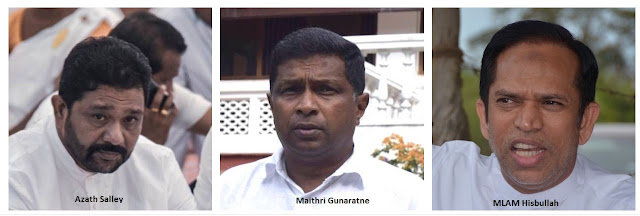
  • specifically named Rishard Bathiuddin and Eastern Province Governor M.L.A.M. Hisbullah as having aided the bombers.
  • accused Western Province Governor Azath Salley of using his influence with the President to release a person apprehended with 100 kg of the powerful explosive C4 in Wilpattu about January this year.
  • Bathiuddin has been clearing the Wilpattu Reservations to settle his people for electoral gain, and that they contain ISIS training camps in the southern end of Musali DS Division (Mannar). It is 4-5 km long says Lohathayalan
https://www.colombotelegraph.com/index.php/the-presidents-men-how-three-sirisenas-governors-were-linked-to-national-thowheed-jamath/
Mr. Rishard Bathiuddin, a rehabilitated LTTE cadre testified to me (Ratnajeevan H. Hoole or Nirmalanathan) that in the last days of the war they transferred money from LTTE storehouse loot in Mullaitivu to Bathiuddin in exchange for food. It was a very lucrative business for Bathiuddin according to my informant.

Complaints from Nirmalanathan and other TNA officials that Bathiuddin has been clearing the Wilpattu Reservations to settle his people for electoral gain, and that they contain ISIS training camps in the southern end of Musali DS Division (Mannar). It is 4-5 km long says Lohathayalan

Bathiuddin has a building by the sea in the Mannar DS division says Lohathayalan. Ships take off directly from the building — containing what, no one knows. Bathiuddin’s brother has been taken in by the police for questioning say news reports and – surprise, surprise – released quickly.
Kilinochchi Catholics Escape
  • Young lady dressed like a Tamil (long ankle-length skirt and blouse with head uncovered) arrives at 5:40 and waits.  Left as there was a long wait for the EucharistFr. Jesudas recognizes Pulasthini Rajendran (a.k.a. Sarah) as the fifth wanted person photos.


-------
These are excerpts from an article in Colombo Telegraph by Ratnajeevan Hoole.  Formatted to be read in point form.
https://www.colombotelegraph.com/index.php/our-governments-role-in-promoting-wanton-violence/


Tuesday, April 23, 2019

2019 Easter Massacre in Sri Lanka.

There were plenty of indications that some kind of incident was going to occur.  Some Muslim Leaders/Politicians had warned the govt of possible terror attack, some even naming possible suspects*. The incidents or information were either ignored or worse perpetrators were released.

*This is quite different from main stream Tamil politicians who kept shielding at minimum or encouraging the LTTE who were referred to as our "boys". eg SJV Chelvanayagam, Amirthalingam etc who finally were assassinated by the "boys".


Possible reasons for Inaction by the Govt
a) In fighting within the govt and finger pointing at the previous Rajapakse regime.
b) Current govt and President were elected on a minority vote and reluctance to clamp down on a segment of their constituency.

A simple timeline
a) December 2018.  Buddhist Statues vandalized in Mawanella
b) December 2018: Pattern of denial that radical Muslims exist.  See comments in link below.
     https://twitter.com/azzamameen/status/1078290050498977799?lang=en
c) January 2019:  Two suspects in Mawanella traced to coconut estate in Wanathavilluwa**. 
                              Large quantities of explosives found.
      http://mirrorcitizen.dailymirror.lk/2019/01/23/damaging-buddha-statues-father-of-the-two-accused-arrested/

d) March 2019: Mohamed Razak Taslim,  Minister Kabir Hasims's Coordinating Secretary is shot by muslim extremists.  Taslim had been assisting the CID  in investigating December 2018 vandalizing of Buddhist statutes.
e) April 2019: Easter Sunday Massacre targeting Christians and Westerners: 300+ killed.

**Wanathavilluwa is kind of middle of nowhere, big (for SL) rolling coconut Farms/estates and scrub jungle, but still a center.  10 km from Wilpattu National Park (Jungle).  140 km from the Colombo center.   From nearby Kalpitiya or Karaithivu by  boat approx 100 km to Dhanuskodi or Toothukudi


Mohamed Zahran (Abu Ubaida) also called Moulvi Zahran Hashim

Ancillary Information
a) National Thowheed Jamath (NTJ) and leader Mohamed Zahran (Abu Ubaida) also called Moulvi Zahran Hashim were responsible for the massacre.
b) Note there is Sri Lanka Towheeth Jamaath (SLTJ)., Ceylon Towheeth Jamaath (CTJ)and a  Tamil Nadu Thowheed Jamaath.
c)  Apparently Moulvi Zahran Hashim and NTJ have/had YouTube videos in Tamil calling for killing of Kafirs (non Muslims) and jihad. The local villagers say those videos were common and had watched at least some of them.

What can be done
a)  Stop teaching of Arabic after school.  All the Muslim children in this village do two hours of Arabic lessons after school. Prevention is better than cure
b) Moulavi/Lebbes visiting Pakistan or Saudi Arabia should be kept under investigation.
c) Madrassas should be investigated.
d) Either heavy military presence in mono ethnic enclaves, including Jaffna. Or change in population composition, if needs be by State intervention, so be it.
e) Foreign Aid, donations cannot be to a single ethnic group or religion.

Some excerpts

http://www.ft.lk/top-story/Blame-game-over-terror-attacks/26-676853
Meanwhile, Highways and Road Development Minister Kabir Hashim claimed that some of the members linked to the NTJ and suspected to be responsible for the terror attacks on Sunday had earlier been arrested over the Wanathawilluwa explosives raid on 18 January but were later released.

“I have been informed that one or two persons that were arrested during Wanathawilluwa explosive haul were released by the Police because of political influence. There is speculation that one person that got released was involved in a suicide attack on Sunday,” he added. However, Hashim said that he could only confirm this information within the next couple of days.

Police also identified the suicide bomber of the Shangri-La Hotel as Imzaan Seelavan. Presenting evidence before the Colombo Magistrate’s Court on Tuesday, Police said that Seelavan’s wife, his brother and two children had died in the explosion in Dematagoda on Sunday.

Seelavan, who was an owner of a factory in the Wellmapitiya area, had about 100 people in his employment, Police told courts. Nine of his employees had been arrested during a joint operation by the Colombo Crimes Division and Terrorist Investigation Department (TID). The nine suspects were remanded till 6 May. Court ordered Police to conduct an in-depth investigation and present the findings to Court. The magistrate also gave permission for Police to obtain phone records of the nine suspects.

The three Policemen who died in the Dematagoda blasts were posthumously awarded promotions.

-----------------------------------------------

Video of alleged Sri Lanka suspect moments before blast. Looks a nice peaceful run of the mill guy.
Pats the head of a little child before he walks into the church and detonates the bomb.

https://edition.cnn.com/videos/world/2019/04/22/sri-lanka-attack-new-surveillance-video-kiley-pkg-lead-vpx.cnn

Sunday, February 3, 2019

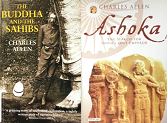
Review: The Buddha and the Sahibs and Ashoka—The Search for India’s Lost Emperor.


A review by my Uni batch mate, Sunil Koswatta

Charles Allen has written two books on The Buddha and the Sahibs and Ashoka—The Search for India’s Lost Emperor. The second book, written about a decade after the first one, is largely an expansion of the first.

 
Both are the stories of the “Orientalists” who discovered India’s lost history, the lost Emperor Ashoka, and the Buddha Dhamma that thrived in India during Ashoka’s time. Their methods of discovery were crude, sometimes outright criminal by today’s standards. However,there were honest“sahibs” who dedicated their whole lives to science and discovery; conversely, there were opportunistic and greedy “sahibs” whose only objective was wealth. Allen weaves his tale in a way to take the readers along with the discoverers while (mostly) permitting the readers to judge for themselves.

Among the most interesting are William “Oriental” Jones, who established the Asiatic Society of Bengal; James Prinsep, who deciphered Ashoka texts; George Turnour, who translated Mahawansa from Pali to English; Alexander Cunningham, who discovered many of the Buddhist pilgrimage sites; Dr. Waddell, who discovered Kapilavastu and Lumbini; and John Marshall, who finally introduced proper methods of archeological excavation.

Prinsep worked to decipher the lettering on the pillar known as the “Feroz Shah’s Lat” or “Delhi No 1” for four years. His breakthrough came when he examined two dozen brief inscriptions of the same lettering at the Great Stupa at Sanchi. Prinsep guessed that these short inscriptions could only be records of donations. He was struck by the fact that almost all short transcripts ended with the same word with two characters: a snake-like squiggle and an inverted T followed by a single dot. 
Here, he observed that the language was not Sanskrit but a vernacular modification of it, which had been fortunately preserved in Pali scriptures of Ceylon and Ava, a nineteenth century Burmese kingdom.
 Prinsep’sassistant with Pali was a Sinhalese named “Ratna Paula” (quite likely a corruption of the name “Rathanapala”).Both in Sanskrit and in Pali, the verb “to give” was “dana” and the noun “gift” or “donation” was “danaṁ” sharing the same Indo-European root as the Latin “donare” (to give) and “donus” (gift). This led to the recognition of the word “danaṁ,” teaching Prinsep the two letters, d and n of Brahmi 1. The snake-like squiggle represented the sound “da”, and the inverted T with the single dot the sound “naṁ.” 
Too, Prinsep noticed that a single letter (like an inverted y) appeared frequently before or near the terminal word. Prinsep determined this letter to mean “of,” the equivalent of Pali “ssa,” based on his earlier investigations of the coins from Saurashtra. If his hunch was correct, then the general structure of each sentence was something like “So-and-so of the gift.”Prinsep’s translation of one such Sanchi inscription is “Isa-palitasa-cha Samanasa-cha danaṁ” (The gift of Isa-Palita and of Samana.)

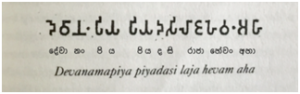
The opening sentence of Delhi No 1 had been observed to repeat itself again and again at the start of many sections or paragraphs of text in the pillar inscriptions and on the rock edicts. This,Prinsep could now read as “Devanampiyapiyadasi raja hevaṁ aha.” After conferring with Ratna Paula, Prinsep concluded that this opening phrase was best represented in English as “Thus spake King Piyadasi, Beloved of the Gods.” Prinsep published his findings in the Journal of the Asiatic Society of Bengal in April, 1837.
 But who was the author of these extraordinary edicts? Who was Piyadasi? Prinsep couldn’t find a Piyadasi in all Hindu genealogical tables that he consulted. Only one possible candidate presented himself, one who had emerged from George Turnour’s translations of the Pali Chronicles of Ceylon: “King Devanampiatissa succeeded his father on the throne of Ceylon in the year of Buddha 236. He induced Dharmasoka, a sovereign of the many kingdoms into which Dambadiva was divided, and whose capital was Pataliputta, to depute his son Mahinda and his daughter Sangamitta, with several other principal priests to Anuradhapura for the purpose of introducing the religion of Buddha.”

In a letter sent to Prinsep on June 6th of 1837, Turnour excitedly revealed the identity of Piyadasi. “I have made a most important discovery. You will find in the introduction to my Epitome that a valuable collection of Pali works was brought back to Ceylon from Siam, by George Nodaris, mudaliar in 1812. This collection of Pali texts included a copy of the Island Chronicle, the original chronicle from which the later Great Dynastic Chronicle took its earliest historical material, but a less corrupted version—and with crucial differences. While casually turning the leaves of the manuscript I had hit upon an entirely new passage relating to the identity of Piyadasi … who, the grandson of Chandragupta, and own son of Bindusara, was at the time Viceroy of Ujjayani.” King Devanmpriya Piyadasi of the Feroz Shar Lat inscription (Delhi 1) was not King Devanampiathissa of Lanka, as Prinsep had assumed. He was his Indian contemporary Ashoka Maurya.

After Prinsep’s death his work was continued. Alexander Cunningham relied on the accounts of the Chinese pilgrims Faxian and Xuanzang to discover the Buddhist pilgrim sites. Faxian’s Records of Buddhist Kingdoms was translated in 1836, and Xuanzang’s History of the Life of Xuanzang and His Travels in India was translated in 1853. Faxian, who travelled to India in 400 CE, identified Ashoka as Wuyou Wang (The King Not Feeling Sorrow). Faxian visited Sankisa, and Lumbini, and from Lumbini travelled south to cross the Ganges at the point he describes as “the confluence of the five rivers,” just upstream of the capital of the country of Maghada: Pataliputra. Faxian describes Wuyou’s palace and his towering city walls and gates as being inlaid with sculpture-work. About two hundred years later, when Xuanzang arrived, the Buddha Dhamma was in decline and the Pataliputra was all but abandoned. Cunningham conducted his field surveys with copies of Faxian’s andXuanzang’s travels in his knapsack. He tracked down almost all sites visited by the Chinese pilgrims, including Sravasti, Kosambi, Ayodya, Sankisa, Taxila, and Nalanda.

However, Cunningham assumed that Pataliputra must have been swept away by the changing course of the Ganges. Dr. Waddell thought otherwise. Taking together both Faxian and Xuanzang accounts,Waddell prepared a chart of Ashoka’s palaces and other chief monuments, and his chart led him over a railway line that marked the southern limits of “old” Patna, to a series of mounds known as Panch Pahari or the Five Brothers. He wrote afterwards, “I was surprised to find most of the leading landmarks of Ashoka’s palaces, monasteries, and other monuments when reexamined so very obvious that I was able in the short space of one day to identify many of them beyond all doubt.” Around the modern village Kumrahar, Waddell found various fragments of sculpture and other confirmatory details and learned from the villagers that whenever they sunk wells, they stuck massive wooden beams at a depth of about 20 feet beneath the ground. Megasthenes, a Greek diplomat who stayed at Pataliputra for six months during the Emperor Chandragupta’s reign, had recorded that Pataliputra was surrounded by wooden walls.

As mentioned before, not all sahibs treated their objects respectfully. James Campbell, the Commissioner of Customs, Salt, Opium and Akbari in Bombay Presidency in the 1890s, excavated several sites in Gujarat. Among his early triumphs was finding a new Ashokan rock edict, which he had allowed to be taken to bits, mislaid, and lost. A relic subsequently identified by the accompanying inscription as a segment of Buddha’s alms bowl was thrown away. He then moved on to tear apart the “Girnar Mound,” a large stupa a few miles south of the famous Girnar rock inscription. In spite of some irresponsibility, all of these men contributed to the rediscovery of India’s past. The books that tell their stories are excellent, and in this reviewer’s judgment both belong in any Sri Lankan’s private library.

Sunil Koswatta

Tuesday, October 2, 2018

The Norwegian Tamil Diaspora

Life on the Outside: The Tamil Diaspora and Long Distance Nationalism by Øivind Fuglerud (1999).

Not a review of the book, just excerpts.  I found the book unbiased in my opinion.  The first chapters are a background of how the separatist movement evolved. The latter chapters are on the dynamics of the Tamil Diaspora in Norway.  The excerpts are from that part of of the book.
  • Link to the pdf of the book at end of post.  
  • YouTube video of life in the Tundra at end of post.
Vasanthan, Thank you very much for sending the book link

Excerpts

A more radical change in climate and nature than that between Sri Lanka and Norway is difficult to imagine and if one is going directly the journey may be made in less than twelve hours. One Tamil lady explained to me how, arriving in the middle of winter with the snowdrifts high against the houses, she believed that people in this part of the world lived in underground caves

A refugee counsellor in the northern part of the country told me how a young Tamil boy due to be settled in the township where she worked had desperately clung on to the aeroplane steps, refusing to come with her into town. Seeing the barren, snow-covered environment he was convinced he was being banished to somewhere outside human habitation.

When he was moving to another town I asked Sri, a moderate LTTE supporter, how he would go about getting acquainted if he met a fellow countryman at his new working place. He answered: I will begin by asking him if he has any news from home, that is our standard opening. Then I will ask him what he thinks about this or that of the recent development in Sri Lanka. If I understand he supports the movement I may invite him home. If he criticises the Tigers but is basically neutral, we may keep on talking at work. I am not a fanatic, I don’t mind that. If I understand he is a member of one of the other groups, however, I will break off. I don’t want to socialise with traitors.

In dealing with fellow countrymen there is always the possibility that actions in Norway will have consequences in Sri Lanka. Tamil refugees are not fleeing a common enemy, the violence is within as much as on the outside. ‘They are here, don’t speak’, newcomers will be informed upon arrival. ‘LTTE is here, I cannot speak’

Even Wilson, a founding member of the LTTE who was permitted to leave the organisation after a dramatic escape from Batticaloa prison in the early 1980s, found that after finally obtaining a visitor’s visa for his mother she was being held back byhis former friends in Jaffna. ‘ Theyjust want to remind me that they know where I am’, he said to me. ‘They are afraid that after ten years in Norway I may be tempted to write a book or something.’ In fact, from 1990 this effort to execute control beyond their own borders has been institutionalised through a very strict exit control in the Tamil areas of Sri Lanka, which includes the obligatory signing of a ‘contract’ by a guarantor staying behind.

As already indicated, in Norway many Tamil refugees have in fact violated the ‘first-country’ regulation on their way. To remain in Norwaytheymust make up a storyand stick to it.

The idea that Tamils in exile tend to give each other away is part of the current self-understanding, a situation which prevents a communicative sharing of life histories. Most of my informants asked me not to tell their stories to other Tami

Another man asked me to take care of his passport when he was kicked out by his wife and had to staywith friends for some time. ‘You cannot trust Tamils when it comes to passports’, was his laconic comment

When the possibility of sending home Tamil asylum seekers came up for renewed
discussion in 1994, a frenzybroke out in one of the small northern settlements. It incited people to go to the police on their own initiative and provide what little information they had about their neighbours. Within a few days local immigration authorities were able to establish that, of the 120 Tamils resident in the village, more than 40 had been living in Switzerland before coming to Norway.

For example, it is a well-known fact among Tamils that in Norway the local LTTE people were for a number of years allowed to monopolise positions as interpreters for the immigration police.
That interaction between a police officer and a refugee in a situation of interrogation is on unequal terms, defined by the context and scale of Western immigration, is readily understandable. But when the refugee is afraid of telling his story to the police officer because of the interpreter’s connections to the militant opposition in Sri Lanka and this interpreter is employed by the Norwegian police, where do we draw the boundary of the system?


In terms of inter-personal relationships social fragmentation is not readily apparent to outsiders. To a Norwegian the first impression of Tamil life is one of dense sociality.

the divide among Tamils in Norway has been on an LTTE /anti-LTTE basis. LTTE is today the only militant group with a properly working organisation in Norway, keeping offices in the main cities and having more or less official representatives in most Tamil settlements.

Prabhakaran, lacking resources of his own, had temporarily joined the organisation TELO which was then under leadership of two militant leaders called Kuttimani and Thangathurai. Together with them he was supposed to have taken part in a famous armed robbery of the Neervely Bank in Jaffna. The second was that subsequently Prabhakaran had personally tipped off the Sri Lankan police on the whereabouts of Kuttimani and Thangathurai, this information leading to their arrest and, as a result of this arrest, their death in the Wellikade prison massacre.

On 1 May 1994 the writer and publisher, Sabaratnam, was killed by unidentified gunmen at his home in Paris

Critics of the LTTE in Norway pointed out to me that shortly before his death Sabaratnam had written an article in the Canadian magazine Thayagam. In this article Sabaratnam had observed that all who participated in the Neervely Bank robbery, except Prabhakaran himself, were now dead, killed either by the Sri Lankan authorities or by the LTTE. He implied that Prabhakaran saw it in his interest to remove the other participants in the action in order to conceal his own co-operation with TELO.
Sabaratnam had promised to return with another article disclosing the real story behind the robbery and the capture of Kuttimani and Thangathurai, but was killed before this could take place – allegedly by the LTTE itself. By the adherents of the Thayagam version, the killing of Sabaratnam and Prabhakaran’s betrayal in the late 1970s were seen as closely connected events which should make people turn their backs on LTTE activities in exile. Not only did Prabhakaran’s tip-off constitute a collaboration with the enemy, but the killing of Sabaratnam reached the lowest possible level of human baseness. It was claimedby people familiar with the early history of the militant movement that in the mid-1970s, years before the Neervely robbery, when Sabaratnam himself was a political activist in Jaffna, he had taken Prabhakaran into his house while he was wanted by the police and had kept him in hiding for several weeks, putting his own life in danger. Repaying this old debt with murder constituted a breach with the militants’ most fundamental ‘code of arms’ and, by implication, left his organisation, LTTE, without any legitimate claim for support.

Tamils are the group of immigrants with the highest rate of employment and with the lowest level of welfare support in Norway. One reason for this situation is the acceptance of the kind of work which is not in demand. In Oslo, according to a recent statistical survey (Djuve and Hagen 1995), only 1.3 per cent of Tamils’ income comes from welfare, as compared to, for instance, 41.7 per cen among Somalis and 37.5 per cent among Vietnamese. In fact, the Tamil level of welfare support is lower than among Norwegians (2 per cent).

In this rather inhospitable area Sri Lankan Tamils have won a reputation as workers in the factories where fish is cut and packed. Even if the numbers are small, seldom more than 50 to 100 in one village, statistics will show that in several villages Tamils represent 5 to 10 per cent of the total population

In the anthropological literature the dowry has generally been regarded as a pre-mortem inheritance to the daughters of a family (Comaroff 1980). In the prevailing war situation it is normally a chosen son who pre mortem inherits the realisable capital of the family and invests it in migration against taking further responsibility for his native family upon himself. This implies, inter alia, that he must procure his sisters’ dowries before establishing a family on his own.  (my comment: This is one of the biggest differences between Tamil and Sinhalese culture, among the Tamils (and northern muslims) the house goes to the daughters, among the Sinhalese the house goes to the son)


most Tamil asylum seekers arriving in the early 1980s had been granted recognition as refugees while those arriving after 1986 had not. In their understanding this was related to the fact that most of these early applicants had been active LTTE-members, in other words that Norwegian authorities intervene and take sides in internal conflicts, caring less about the killed than about the killers.

from people who have fled to get away from their dictatorship in Sri Lanka and have relatives still suffering under their rule there. It is here, at this precise point, that the spirit of selfsacrifice of the LTTE soldiers becomes important. The actual materiality of death makes it difficult not to believe the LTTE when they say that their fighters die on behalf of the Tamil nation. Even people who in public take upon themselves the burden of speaking against the LTTE may sometimes admit in private conversations that, emotionally, they are not able to free themselves from sympathy for the organisation and its cause.

In 1903, for example, there were 2021 Jaffna-Tamils employed as functionaries in the federated Malay States Railways compared to 84 Sinhalese, 278 Malays and 1084 Chinese (Ramasamy 1988).In 1903, for example, there were 2021 Jaffna-Tamils employed as functionaries in the federated Malay States Railways compared to 84 Sinhalese, 278 Malays and 1084 Chinese (Ramasamy 1988).

The main reasons why Ceylon Tamils were favoured by the British administrators were their recognised industriousness and their fluency in English. As noted in Chapter 2, at the turn of the century the Tamil community already had a long-standing relationship with English speaking missionaries. The acquiring of language proficiency was, however, not a passive process. Education was an asset seized upon by the ambitious, something that aspiring Jaffna families put their minds to without regard for the costs.

Migration to areas like British Malaya was clearly one way of ‘converting . English education into cash’. The Money Order remittances returned to Ceylon in a good year like 1918 totalled 736,652 Ceylon rupees from the Federated Malay States and 289,651 rupees from the Straits Settlements, quite substantial amounts at that time. The importance of these remittances was such that on two occasions, with a twentyseven years’ interval, the government agent in the Northern Province found it necessary to point out that it was the money coming from Malaya which accounted for the relative prosperity of Jaffna (Ceylon Administrative Report 1903 and 1930).https://zodml.org/sites/default/files/%5BIvind_Fuglerud%2C_Oivind_Fuglerud%5D_Life_on_the_Outs.pdf