Sunday, March 24, 2013

Politics of Pubic Hair

Shaved genitals have somehow become the new normal for an entire generation of women. Surely it’s time we asked why.

I gather its starting to be common in Sri Lanka too.  Probably because it is a requirement for household domestic employment in the mid-east.


One of the best comments on the article: I like this because I am a vagitarian.


Cut & Paste, GUI, Links in 1968

Douglas Engelbart demonstrates the NLS (“oN Line System”) in 1968.  As Lambert Strether says it took 16 years (1984 – 1968) to  to be adapted successfully for commercialization (e.g. Apple Lisa) . For 45 years ( 2013 – 1968)  Engelbart’s vision or, at least a version of it remains unchanged.
The demo is one hour and forty minutes long,


You will see the first demonstrations of:
  • The mouse
  • The cathode ray tube (CRT) monitor (what we all used before flat screens, if you can imagine such a thing)
  • The graphical user interface (GUI) with windows (as opposed to the previous state of the art, the teletype)
  • The word processor (with cut, copy, and paste)
  • The outliner 
  • Computer generated slides
  • Hypertext with clickable links
  • Video-conferencing
  • More abstractly, “the file,” with file name, creation date, and creator, with navigation through a hierarchy of files
  • And Herman Miller office furniture!

Saturday, March 23, 2013

Women Losing Objects in Their Vaginas: An Online Literature Review

Today, xoJane deputy editor Mandy Stadtmiller blogged about seeking gynecological help to retrieve a tampon that had been stuck in her vagina for several weeks. "I had a dying tampon alien living inside me for almost a month," she wrote.

I am not going to post excerpts.
The whole article is here
http://nymag.com/thecut/2013/03/women-losing-objects-in-their-vaginas-a-review.html?mid=twitter_nymag


via Naked Capitalism

Wednesday, March 20, 2013

Increased Monsoon Rainfall

Monsoons are having higher rainfall and also the possibility of monsoon failure. This is a big deal as we found out last December with flooding all over the country. Our water management needs to take into account even greater rainfall rates. That is expect more rain to fall in shorter time periods but also expect possibility of extended drought.  The one saving grace for Sri Lanka is that we can still have Island Effect rainfall even when the monsoons fail in other parts of the world such as India.
Natural swings in the climate have significantly intensified Northern Hemisphere monsoon rainfall, showing that these swings must be taken into account for climate predictions in the coming decades, a new study finds.
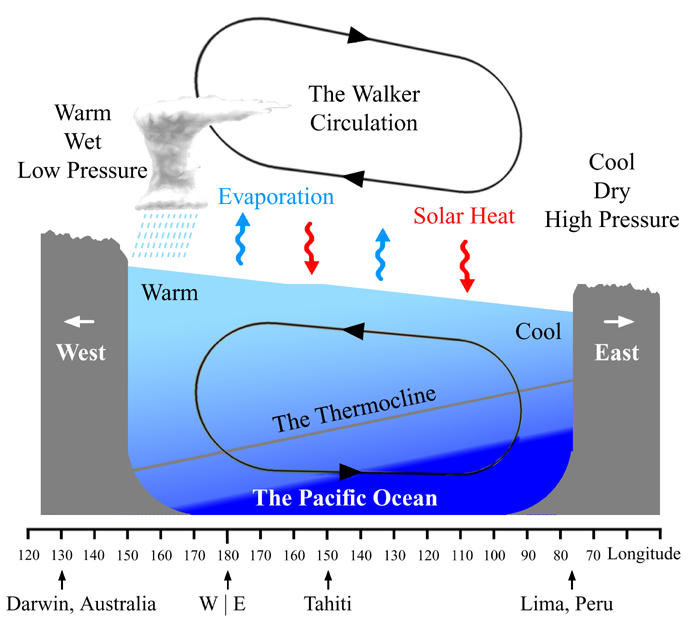
Wang and his colleagues, however, found that over the past 30 years, the summer monsoon circulation, as well as the Hadley and Walker circulations, have all substantially intensified. This intensification has resulted in significantly greater global summer monsoon rainfall in the Northern Hemisphere than predicted from greenhouse-gas-induced warming alone: namely a 9.5% increase, compared to the anthropogenic predicted contribution of 2.6% per degree of global warming.

Most of the recent intensification is attributable to a cooling of the eastern Pacific that began in 1998. This cooling is the result of natural long-term swings in ocean surface temperatures, particularly swings in the Interdecadal Pacific Oscillation or mega-El Niño-Southern Oscillation, which has lately been in a mega-La Niña or cool phase. Another natural climate swing, called the Atlantic Multidecadal Oscillation, also contributes to the intensification of monsoon rainfall.

Other Research finds that Global warming could cause frequent and severe failures of the Indian summer monsoon in the next two centuries, new research suggests.
They found that as we move towards the end of the 21st, and into the 22nd, century, increasing temperatures and a change in strength of the Pacific Walker circulation in spring could cause more frequent and severe changes in monsoon rainfall.

These failures of the monsoon system -- defined in the study as a 40 to 70 per cent reduction in rainfall below normal levels -- were unprecedented in the researchers' observational record, which was taken from the India Meteorological Department and goes back to the 1870s.

from
http://www.sciencedaily.com/releases/2013/03/130320155251.htm
http://www.sciencedaily.com/releases/2012/11/121105200054.htm

Tuesday, March 19, 2013

Roman Dutch Law and Womens Property Rights: Caroline Corner 1908

I've posted the chapter because of its insights into Roman Dutch Law and how it applied to the property rights of women.  (Other Chapters on Orabi Pasha founder of Zahira)

CHAPTER XXI
Justice in Ceylon — The "mills " that grind both
"slowly" and "exceeding small"—"Where every
prospect pleases," &c.—Peter Robinson's parasol
and its achievements—Worthy of opera-bouffe. 

CYNTHIA'S first experience of a Court of Justice in Ceylon—indeed anywhere— caused her to think—fatal condition in woman! Moreover, it caused her to ask questions. Reckless of consequences as her Grandmother Eve, Cynthia's thirst for knowledge goaded her on. Men maintain that once this train is fired in the feminine mind, they are in hapless security of an express ticket to the bottomless pit. Cynthia had not, however, enlisted in the corps of "Shrieking Sisters," nor was she ever likely to. Cynthia was possessed of a mind that demanded food, as did her more material part. Likewise was she endowed with a heart that ofttimes ached at the injustice of man—not "mere man," mankind in the full, broad sense—and sometimes rose in rebellion and hatred of the cruelties perpetrated on the weak around her. On the verandah where, amid the profusion of tropical loveliness, the little black-eyed squirrels peeped out of the purple passion flowers, and tiny tortoises took their walks abroad, and Punch and Sprite lay stretched on guard against cobras and ticpolongas—here, sheltered from the scorching sun, Cynthia loved to sit and muse and dream. Europeans thought she must be lonely. Europeans were mistaken. Cynthia was never lonely. The gamut of her musings was wide—unlimited. The more she thought, the more there was to think, and the wider the gamut grew. From the heights empyrean to—well, perhaps the bottomless pit— everything has interest if one did but take the trouble to look for it—search it out. And even in what might seem to outsiders their monotonous life something was always occurring worth this M thinking out." When she sent a lengthy narration of her Law Court experience to that honoured old friend of her youth, London's late esteemed Judge, the reply she received was: "May not the Rose of Sharon blossom in the wilderness? But briars abound. Take heed lest they choke the sweetness of the Rose." But Cynthia had no desire to emulate certain habitudes of the Courts of Law—her retired life was proof of this. Only from early childhood she had hankered after the "why and wherefore," besides inclining rather to the active than to the passive: never'' Do it for me," but "I'll do it" being her refrain. Thus it was fated to come about, perhaps, that her life should be no easy one. It was interesting, nevertheless. This propensity for problems was only indulged when other material duties were done. No one could accuse Cynthia of neglect of household duties, nor of lack of taste and that finish that only a woman's hand can impart, and which, when wanting, no amount of expensive luxuries can atone for. This is essentially woman's role in the drama of life, and she who does not act up to it is no woman at all—in the true sense. Problems come after.

A new problem had been born from Cynthia's late experience. This was it. Why did not her countrymen on taking possession of the Island of Ceylon take their own law with them? The old Roman Dutch law still prevails in this British First Crown Colony. According to this antique specimen of the balance of justice, a wife can at the caprice or insanity of her husband be not only left totally unprovided for on his decease, but furthermore, deprived of her own, a wife being regarded as a mere chattel of her lord and master, which, tiring of, may be exchanged, nolens volens, when that lord and master chooses to transfer his affections elsewhere. Marriage under such conditions sanctioned by the law of Ceylon is either a farce or a tragedy in which the virtuous heroine —the wife—may be the victim. Withal the Union Jack of Old England waves "o'er Ceylon's spicy Isle "! A case in point came within Cynthia's own experience. A gentlewoman by birth, education, and social environment (in England), wife of a Civil Servant in the Government of Ceylon, was not only deprived of all portion of her husband's property at his decease but was defrauded of her own exclusively—a fact exemplifying a state of things no other civilised country would countenance. The sequel to this sad story was this. The widow of that Government servant in Ceylon, finding herself destitute, had providentially found friends—friends of foreigners in a foreign land, friends likewise of the royal rulers of her own Old England.

"A Constitutional Government," said the latter, compassionating and regretfully. "We can do nothing. It is the law, moreover; no one can interfere." After many months of waiting, during which the widowed gentlewoman might have starved, would indeed have starved, were it not for those friends in need, friends of a true '' high nobility," after weary waiting and months of anxiety a pension was granted. Tennyson might have said:

The mills of" Government" grind slowly,
"And" they grind exceeding "small."  

"It was written," though, as the Moslem would say, that that widowed gentlewoman was not to starve. Cynthia devoted many a leisure hour to thinking this problem out. Moreover, she wrote the whole narration of this cruel case of /wjustice to her friend—the honoured London Judge. His lordship's reply, a voluminous one going into details of the case, she never received. A "custom of the country "—akin to native legerdemain. "It was written" also that Cynthia should have another experience in a Court of Justice in Ceylon —a Police Court only this time, but deserving of narration, if only for the element of humour therein. This is how it happened.

A horse from a batch of "Walers" had recently been purchased. Now this "Waler" had to be trained to both saddle and harness, as well as to become accustomed to those native outdoor "customs of the country" which are as perplexing (when not appalling) to the equine new-comer as were the European social customs to Cynthia. For this purpose Clio, as the animal was christened, had to be escorted by the Mutiu every morning at daybreak from the home at Dehiwella to Colombo, a distance of about six miles. It was usual for horse and man to be back by noon. One day, however, noon came and with it neither. At i o'clock, when Cynthia sat down to tiffin, she inquired again, with the same answer, "Not come, Lady." At 2 o'clock, becoming uneasy, she said, "Appoo, you'd better go yourself—get a hackery—something may have happened."
The Appoo maintained that steady, stubborn gaze of the Sinhalese which, read arightly, means non-compliance. Cynthia had been long enough "out" to know it well.

"Go at once, and you shall have a couple of rupees. Here's seventy-five cents for the hackery."
The steady gaze relaxed, there was the wraith of a smile about the mouth, moreover.
The Appoo went. Afternoon tea-time brought him back—alone.
"Well ?" said his mistress questioningly.
"That horse, Lady, tied to tree. Sinhalese man saying not untie until Lady pay ten rupee."
"What!"
    "That horse, Lady's horse, tied to tree," &c., &c., going over the same to simplify to European density.
"And the Muttu?"
"Muttu there, too, Lady; Muttu not tied to tree; Muttu staying with horse; Muttu not coming back."
"What does it mean ?" ejaculated Cynthia. "Sinhalese man wanting ten rupee, Lady." "Oh yes, I understand that well enough." "But why? How dare he keep the horse?" "Sinhalese man got, Lady: Sinhalese man keep—'less Lady give ten rupee."
Sinhalese logic is simplicity itself, but—onesided. A happy thought struck Cynthia.
"Why didn't you release the horse?"
"Sinhalese man not letting, Lady. Sinhalese man wanting ten rupee first—Lady give?"
"No, I'll be—shot if I do! I'll go myself."
"Very hot, Lady, out-door. No other horse got take carriage, no gharry 'bout this part. Lady —European Lady not going go?"
"I am; and you must go too."

Now the highway from Colombo to Mount Lavinia is one long, hot, dusty road. Picturesque decidedly, with the handsome white bungalows in large gardens on the one side and the native boutiques (shops) on the other, with every sort of human being, descript and nondescript, between. The Sinhalese—indeed, the Oriental has no notion of privacy—he and she, take their baths, dress, do their hair or have it done by the barber in full view of everybody. One sees the queerest sights in Ceylon.

But Cynthia that scorching afternoon was on other business bent. Men—sellers of chatties, fish and what not—might pause to inquire of the Appoo the reason for a European lady being about at that hour and on foot; women might come to the doorways of their cadjan huts and chatter; boys and girls might pester her for cents, "no fadder, no mudder got, Lady!" beggars might increase the tone of their perpetual drone; Cynthia wended her way—the Appoo following. Her loose yet becoming tea-gown held up from the dust, on she went, her parasol the only protection from the tropical sun.
Presently carriages, the carriages of Europeans, varying from victorias to buggies and dog-carts, commenced to scatter the motley yet picturesque throng of natives that always fills the road. Banks, offices had closed. Europeans were either going home or were out for their evening drive. How they looked at Cynthia! Some— and these the best bred, those really high in the social scale—raised their hats; others stared, and if they had their wives and daughters with them, the latter made some sneering remark which, however, the husband, to his credit be it said, did not encourage, but flicking the horse hastened on. Such incidents forced Cynthia to wonder if, when Bishop Heber wrote those lines—

Where every prospect pleases,
And only man is vile, 

they were intended to imply to the "heathen" native alone. May be 'twas the pretty tea-gown that excited envy or derision—which? But what more suitable when the thermometer stands at 110° than a loose muslin robe? Cynthia had at any rate the courage of her opinions and  acted accordingly, let Mrs. Grundy of the Colony deride as she might—or envy!.
 
Wellawatte was passed; Bambalapitiya nearly, when the Appoo, approaching, pointed to a group assembled under the shade of a mango tree.
There was the horse, there the Muttu, and squatting around the animal were some three or four of the lowest caste, most ruffianly looking natives it had ever been Cynthia's misfortune to behold.
"Muttu," said Cynthia, drawing nearer, "release the horse and bring it home."
The Muttu came a step forward—reluctantly.
"Come—quick," continued Cynthia firmly.

But the group of rapscallions were up at this, their hands on the animal's halter, their voices in chorus addressing Cynthia, " Sinhalese men saying wanting ten rupee, Lady," interpreted the Appoo^ standing at a distance, as became his high caste. Cynthia was sharp enough to detect glances being exchanged all round. Freemasonry always exists among the natives in spite of caste—until their individual interests clash.
"Muttu, take the horse—I insist."

But the Muttu made no advance. He either would not or he dared not. Useless to transfer the order to the Appoo. Cynthia came forward herself. Soon as her fingers touched the knot the halter fell from the tree. She was surprised at the success herself. The ruffians, infuriated, surrounded her, talking vociferously, and making endeavours to bar her way. With her sunshade, however, she kept them at bay. Afterwards she said her "good demon must have been at hand and helped," for whilst one hand was occupied with Mr. Peter Robinson's parasol, the other, securing the halter, led the horse away. A sorry situation for an English lady, but Cynthia was blessed with that priceless bump of humour— born with it. It helped her over many a stile. It helped her now. Spite of heat, fatigue, fear (if fear she had) of these low caste native ruffians, Cynthia held on—literally as well as figuratively held her own, leading the animal until, once out in the open road, she insisted again on the Muttu taking her place. This he did now— willingly, his mistress having proven herself, if not the stronger, at any rate the superior power. "Nothing succeeds like success " is true as it is trite with human nature, black as well as white. Thus the procession proceeded homeward. After dinner the Muttu was summoned to the verandah to tell his story of what Cynthia designated this "novel system of equine brigandage." It was this. While leading the animal quietly along the public highroad, some three or four men, suddenly emerging from a side garden, seized the halter out of the Muttu's hand and led the horse away to a mango tree, where they secured it. Upon the Muttu remonstrating, the men—strangers to the Muttu (of course) demanded ten rupees ere the animal should be released or restored. Useless to argue, to reason, or to resist. Ten rupees or the horse remained captive.
Funny, downright funny was this.

"Worthy of French opera bouffe" as Cynthia said. "But—the flag of sober, serious, just old England waves o'er this fair isle." Herein lay the anomaly.
"But," bringing herself back to the gravity of the question, "was there no constable about?" she inquired.
"No," said the Muttu, "no constable 'bout."
"H'm. You may go, Muttu." 

That evening passed merrily, as indeed their evenings always did. Cynthia made sketches of natives being kept at bay with Mr. Peter Robinson's parasol by way of illustration to her graphic encounter with "ye native brigand." The sequel to the adventure occurred a morning or two later, when they were eating their appas again on the verandah. A yellow Malay in blue approaching, handed an envelope, likewise blue. The contents, also blue—a summons to appear at the Colombo Police Court: "Whereas the said So-and-So did permit of his property—a horse and a man—a Muttu in the said So-and-So's service, to trespass on and thereby do injury to the property of Soand-So at Bambalapitiya."

"What audacity! What audacity! Really life is, must be, comic opera in Ceylon."
Ah, Cynthia, not always. Tragedy it may be sometimes. But that's another story.

Monday, March 18, 2013

Beautiful Earth Kitchen

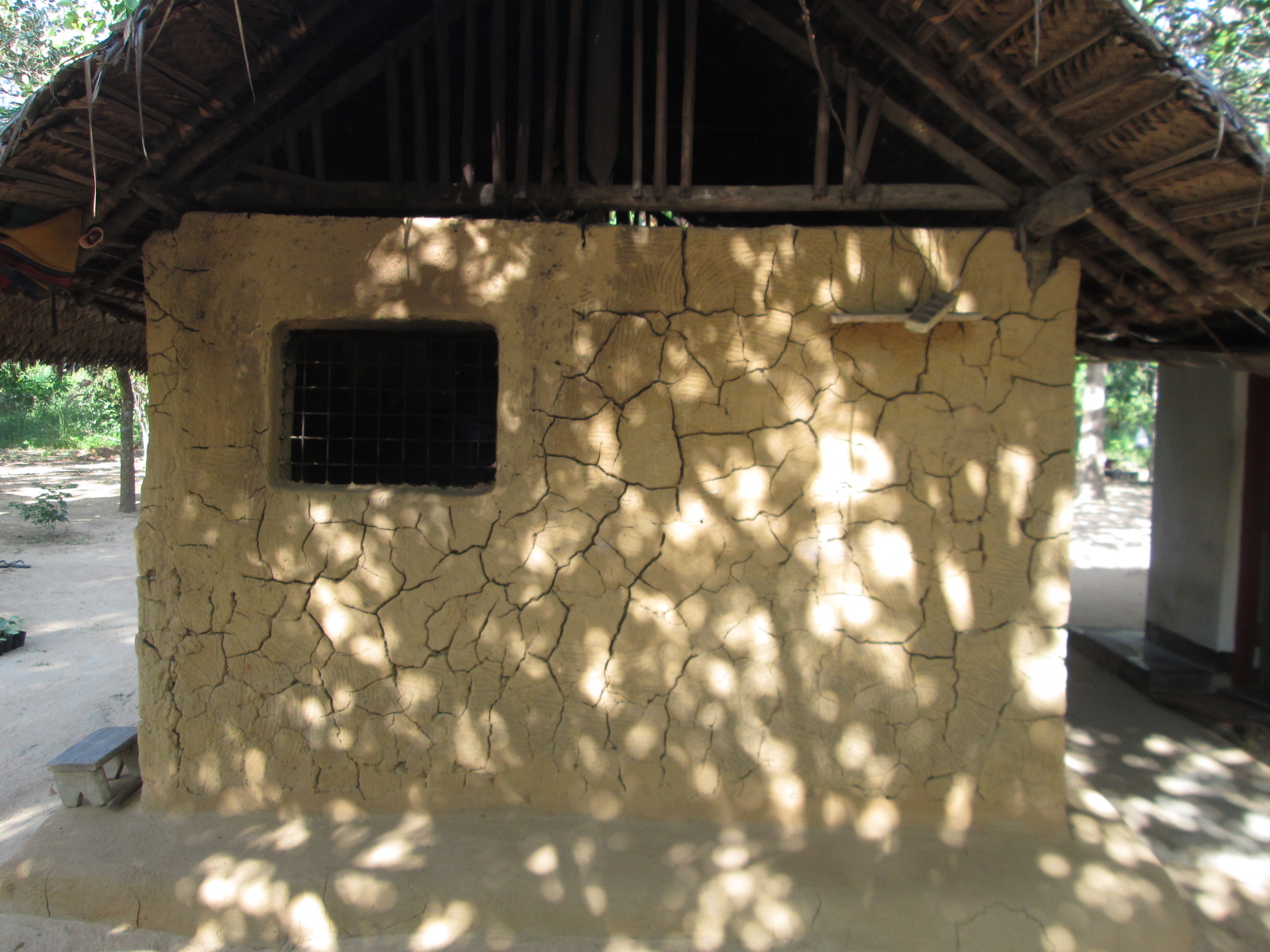
This is a great kitchen made completely with Earth (matti in Sinhala), Not only is it eye catching it is cost effective and very functional.  The kitchen was built by Mr. Dayananda and his wife Sumana by themselves. Mr. Dayananda's wife runs a medium scale plant nursery out in Wanathavillu (on the old Mannar Puttalam road). You may notice that Mr Dayananda is using one of the two or three many efficient ways of cooking with firewood (clay 1950-1978),
a) The double clay stove (CEB Two-pot Stove or the Clay Sarvodaya Version. 
b) Rocket Stoves:  Downside the wood needs to be chopped into small pieces. I have not seen one in SL. Does not mean there are none around. 
We/I use the double stove, readily available all over the country for around 150-250 LKR. It really cuts down on the firewood use and can have two pots being cooked at the same time. Unhappily I rarely see households using the double stove in this part of the country. The women walk half or more kilometer (depending on economic status) and gather firewood even though this area borders jungle. Thats because the village proper, is urban in the sense there are very few trees/firewood within the village.  Some villagers have have even commented after seeing the double clay stove why I bother. Yes some of those houses will have 50K sound setup or 30K flat screen TV, but not a 150-250 LKR stove that will cut down on firewood usage.


Sunday, March 17, 2013

Music: Papare Video Angola (or Brasil ?)

This is a video for MS Fernando's Kekiri (kakiri) Pelena Hinawa.  The music just jives with the dance.  The dance moves look so Sri Lankan, specially when they clasp hands together and lay it against their faces. The other move is when they raise both hand upwardon the left and appear to drag down the hands to the right.
The videos are from Angola (or is it originally from Brasil/Brazil).  Angola (and Brazil) and the largest ex colonies of Portugal. Our Kafiringha music came via Angola. Did some of our popular dance moves too originate from Angola ?
Video of  KUDURO ZOUK to the Papare music of M.S. Fernando


And the original video (?)


Another video of  KUDURO ZOUK no HUAMBO Angola (Group dances KANDIMBA)